

Key points
- Forms W-2, W-3, 1099-NEC, the fourth-quarter Form 941 and Forms 940, 944 and 945 are due February 1, 2027, because January 31 is a Sunday; the four returns can wait until February 10 only if every deposit was on time.
- The 2026 Form W-2 adds box 12 codes TT (qualified overtime), TP (cash tips) and TA (Trump accounts) and splits box 14 into 14a and 14b.
- Contractors paid in 2026 need a Form 1099-NEC only at $2,000 or more, and FIRE closed on November 19, 2026, so 1099s are e-filed through IRIS.
- Reconcile W-3 boxes 2, 3, 5 and 7 with the four 2026 Forms 941 before filing; Social Security wages cap at $184,500 per employee.
- For 2027, load the $192,300 Social Security wage base, the $25,500 401(k) limit, new state minimum wages and state unemployment rates, and collect new exempt Forms W-4 by February 16, 2027.
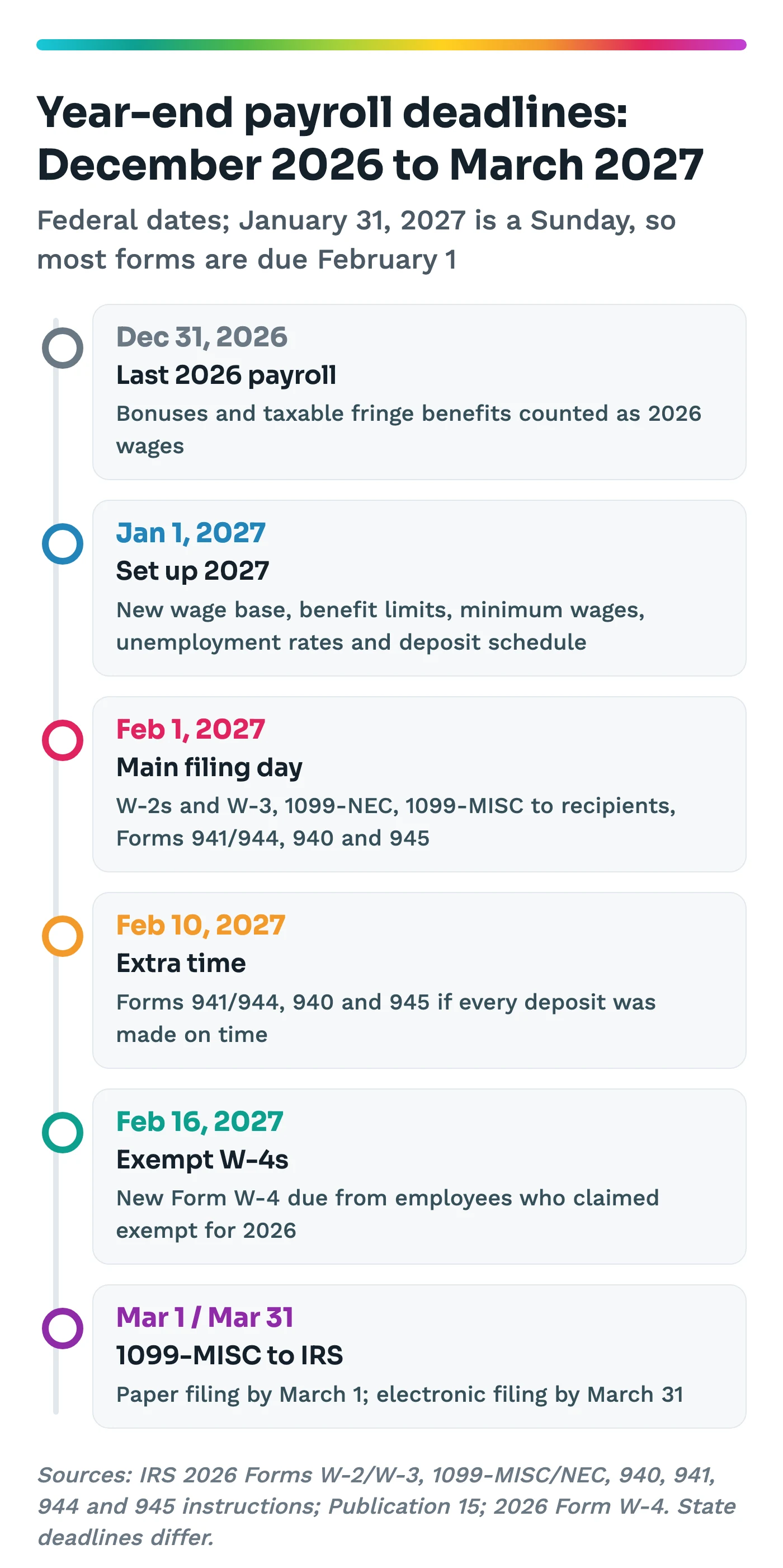
A year-end payroll checklist for 2026 has more new lines than usual. The 2026 Form W-2 adds codes for qualified overtime and tips, the federal 1099 threshold rises to $2,000, and the IRS’s FIRE system has closed. Most year-end returns and employee forms are due February 1, 2027, because January 31 falls on a Sunday, and the table below sets out each task, deadline and form from December 2026 through March 2027.
Year-end payroll checklist: key dates from December 2026 to March 2027
Each row names the form involved and the official source for the date. Payroll is one part of the wider HR compliance checklist, which covers hiring, leave and training duties for the same period.
| Task | Deadline | Form | Source |
|---|---|---|---|
| Run the last 2026 payroll, including any bonus meant to count as 2026 wages | Last pay date in 2026 (Thursday, December 31 at the latest) | W-2 boxes 1, 3 and 5 | 2026 W-2/W-3 instructions (wages count in the year paid) |
| Add taxable fringe benefits to wages, or apply the special accounting rule to November and December benefits | Treated as paid by December 31, 2026 | W-2 boxes 1, 3, 5, 12 (code C) and 14a | Pub. 15-B |
| Set the 2027 deposit schedule from the July 1, 2025 to June 30, 2026 lookback period | Before January 1, 2027 | Form 941, line 12 totals | Pub. 15 |
| Load 2027 rates: Social Security wage base, benefit limits, minimum wages, state unemployment rates | First 2027 payroll | Payroll system setup | SSA, IRS Notice 2026-66, state agencies |
| Finish valuing 2026 fringe benefits | No later than January 31, 2027 | W-2 boxes 1, 3 and 5 | Pub. 15 |
| Furnish W-2s to employees; file Copy A with Form W-3 at the SSA | February 1, 2027 | W-2, W-3 | 2026 W-2/W-3 instructions |
| Furnish and file Form 1099-NEC (e-file through IRIS at 10 or more returns) | February 1, 2027 | 1099-NEC | 1099-MISC/NEC instructions; Pub. 1099 |
| Furnish Form 1099-MISC to recipients | February 1, 2027 (later for boxes 8 and 10) | 1099-MISC | 1099-MISC/NEC instructions |
| File the fourth-quarter Form 941, or the annual Form 944 | February 1, 2027 (February 10 if every deposit was on time) | 941 or 944 | Form 941 and Form 944 instructions |
| File Form 940, with Schedule A for multi-state or credit reduction state wages | February 1, 2027 (February 10 if all FUTA tax was deposited when due) | 940, Schedule A | Form 940 instructions |
| File Form 945 for backup withholding on nonpayroll payments | February 1, 2027 (February 10 with full, timely deposits) | 945 | Form 945 instructions |
| Collect a new Form W-4 from employees who claimed exempt for 2026; otherwise withhold as Single or Married filing separately with no adjustments | February 16, 2027 | W-4 | 2026 Form W-4; Pub. 15 |
| File paper Forms 1099-MISC with the IRS | March 1, 2027 (March 31 if filed electronically) | 1099-MISC | 1099-MISC/NEC instructions |
| Applicable large employers: furnish Form 1095-C to full-time employees, and file Forms 1094-C and 1095-C (e-filed through the AIR system) | Furnish by March 2, 2027; file by March 1, 2027 on paper or March 31, 2027 electronically | 1094-C, 1095-C | Form 1094-C/1095-C instructions |
| Recover from the employee any income tax you deposited but did not withhold, such as on a fringe benefit | Before April 1, 2027 | None | Pub. 15 |
Two dates catch employers out. The February 10 filing date for Forms 941, 944, 940 and 945 applies only when every deposit for the period was made in full and on time; one late deposit puts the return back to February 1. And the February 16 date for exempt Forms W-4 comes from the 2026 Form W-4 itself, because February 15, 2027 is Washington’s Birthday, a legal holiday.
What should you check before the last payroll of the year?
Fixing a name, address or tax setting before the final 2026 payroll costs far less than correcting a filed W-2. Run these checks in early December, while a pay date is still left to adjust withholding:
- Names and Social Security numbers. The W-2 must show the name exactly as it appears on the employee’s Social Security card, and the last name matters most. Run new hires and name changes through the SSA’s Social Security Number Verification Service so wages post to the right earnings record.
- Mailing and email addresses. Confirm addresses for current and former employees who will receive a 2026 W-2, and check that anyone receiving an electronic W-2 has given the consent described in Pub. 15-A.
- Work locations. Review state and local tax setup for remote and hybrid staff who moved during 2026. A move payroll never recorded leaves wages and withholding on the wrong state’s W-2 lines.
- Worker classification. A contractor who should have been on payroll needs to be fixed before W-2s and 1099s go out. The independent contractor vs employee test compares the IRS, DOL and state tests.
- Social Security and Medicare limits. Social Security tax stops when an employee’s 2026 wages reach $184,500, a maximum of $11,439 in employee tax. Medicare has no cap, and you must withhold the 0.9% Additional Medicare Tax on wages you pay an employee above $200,000 in the year.
- Overtime and tip data. Confirm FLSA status and tipped occupation codes now, because they drive the new W-2 codes covered below.
- Exempt Forms W-4. List every employee who claimed exemption from withholding on a 2026 Form W-4. That exemption ends with the 2026 tax year.
- Off-cycle pay. Gather totals for third-party sick pay, manual checks, voided checks and prior-period adjustments so year-end totals match what employees actually received.
Year-end payroll fringe benefits and bonuses: what goes into 2026 wages
Taxable fringe benefits are wages, and all benefits provided in a calendar year must be treated as paid by December 31. Under Pub. 15, you have until January 31 of the next year to determine their value and may use reasonable estimates for withholding and deposits before then. The 2026 Publication 15-B covers each benefit in detail.
The special accounting rule for November and December
You may treat the value of noncash fringe benefits actually provided in November and December 2026 as paid in 2027, together with benefits provided in the first 10 months of 2027. The rule is optional and can be used for some benefits but not others. Once you use it for a benefit, it applies to every employee who receives that benefit, and it cannot be used for transfers of real property or property normally held for investment.
Taxable items to include on 2026 W-2s
- Personal use of a company vehicle: value personal miles under one of the Pub. 15-B valuation rules and add the amount to wages.
- Group-term life insurance over $50,000: include the cost of coverage above $50,000 (from the IRS Table 2-2 rates), less any amount the employee paid, in boxes 1, 3 and 5 and in box 12 with code C.
- Health coverage for 2% S corporation shareholders: include the premiums in box 1 wages. They can generally be left out of Social Security, Medicare and FUTA wages when paid under a plan for employees.
- Dependent care assistance: the exclusion rose from $5,000 to $7,500 ($3,750 for married filing separately) for 2026. Report all assistance in box 10 and any amount above the exclusion in boxes 1, 3 and 5.
- Moving expense and bicycle commuting reimbursements: both are taxable. The moving exclusion survives only for active-duty military moves under orders and for intelligence community employees relocated by a change in assignment, and the bicycle exclusion ended for tax years after 2025.
- Educational assistance: up to $5,250 under a qualifying program, including employer payments of student loans, stays tax-free for 2026. Amounts above that are wages unless they qualify as working condition benefits.
- State paid family and medical leave: new in the 2026 W-2 instructions, employee contributions and any employee share the employer pays voluntarily are reported as wages (Rev. Rul. 2025-4 and Notice 2026-6).
- Trump account contributions: employer contributions under a section 128 program, permitted from July 4, 2026, go in box 12 with code TA.
Should bonuses be paid in the last payroll of the year?
Only if they are meant to be 2026 wages. W-2 amounts are based on wages paid during the calendar year, not when the work was done. The IRS’s own example: wages for work from December 13 to December 26, 2026, paid on January 1, 2027, go on the 2027 Form W-2. A bonus pushed into January also counts toward the 2027 Social Security wage base and 2027 deferral limits instead of 2026.
Bonuses are supplemental wages. When a bonus is paid separately from regular wages, and you withheld income tax from the employee’s regular wages this year or last year, you may withhold federal income tax at a flat 22%, and you must use 37% on supplemental wages above $1 million paid to one employee in the year. The recorded supplemental pay webinar on bonuses and fringe benefits walks through the optional and mandatory flat-rate methods.
Year-end payroll reconciliation: matching W-2s to Forms 941 and W-3
The SSA processes W-2s and shares the totals with the IRS, which compares them with your four quarterly Forms 941 or your Form 944. If they do not match, you will be contacted to explain the difference. The 2026 General Instructions for Forms W-2 and W-3 set out the comparisons:
- Federal income tax withheld: W-3 box 2 against the year’s total withholding on the four Forms 941, including current-year adjustments.
- Social Security and Medicare wages: W-3 boxes 3, 5 and 7 against the four quarters’ lines 5a, 5b and 5c. Include current-year adjustments only; prior-year corrections stay off the 2026 W-2s.
- Social Security and Medicare tax: the Forms 941 totals should be about twice W-3 boxes 4 and 6, because the 941 includes the employer share.
- Per-employee limits: no boxes 3 and 7 together above $184,500, no box 5 lower than boxes 3 and 7 combined, and no box 4 amount when boxes 3 and 7 are both zero.
- Deposits: deposits made through EFTPS against the liabilities on Form 941 line 16 or Schedule B, so any fourth-quarter shortfall is paid by February 1, 2027.
- Box 1 against boxes 3 and 5: explain each difference. Pre-tax 401(k) deferrals reduce box 1 but not boxes 3 and 5; cafeteria plan health premiums reduce all three.
- FUTA and state wages: Form 940 taxable wages (the first $7,000 per employee) against state unemployment wage reports, and W-2 state wages and withholding against state returns.
- General ledger: payroll register totals against wage expense and payroll tax liability accounts.
Totals can differ for valid reasons, such as a prior-year adjustment on a 941. Record the reason and keep the reconciliation file, as the instructions suggest, in case the IRS or SSA asks.
Year-end payroll reports to run
- Year-to-date payroll register by employee, showing taxable wages by tax type
- Quarterly tax liability report and EFTPS deposit history
- Totals from all four Forms 941 and the state quarterly returns
- Deductions and benefits report: 401(k), HSA, health FSA, dependent care and garnishments
- Imputed income and fringe benefits report
- Employees over the Social Security wage base or the $200,000 Additional Medicare threshold
- Overtime and tips report by employee for codes TT and TP
- Terminations, address changes and multi-state employees
- A W-2 preview or audit report, checked before final printing or upload
What’s new on the 2026 Form W-2?
The 2026 Form W-2 is the first with mandatory reporting under the One Big Beautiful Bill Act, and the penalty relief that covered 2025 forms does not carry forward. The changes payroll must set up are:
- Box 12, code TT: total qualified overtime compensation, meaning the FLSA-required premium above the regular rate, with no cap applied.
- Box 12, code TP: total cash tips the employee reported to you.
- Box 14b: up to two Treasury Tipped Occupation Codes. The old box 14 “Other” becomes box 14a.
- Box 12, code TA: employer contributions to Trump accounts.
- $2,000 wage reporting threshold: for wages paid after 2025 with no income, Social Security or Medicare tax withheld, a W-2 is required at $2,000 instead of $600.
- Penalties: for returns due in 2027, $60, $130 or $340 per W-2 depending on how late the correct form is filed, and at least $690 per form, with no annual cap, for intentional disregard.
Overtime and tips are still taxed and withheld; only the employee’s deduction changes. Errors in code TT, code TP or box 14b are corrected on Form W-2c, and employees cannot deduct overtime the employer leaves off. The calculation method, worked examples and box rules are in the guide to no tax on overtime W-2 reporting.
Year-end payroll tax forms: W-2 and 1099 deadlines for 2027
January 31, 2027 is a Sunday, so the annual employer forms move to Monday, February 1, 2027.
Forms W-2 and W-3
Furnish W-2s to employees and file Copy A with Form W-3 at the SSA by February 1, 2027, on paper or electronically. If you file 10 or more information returns in total, you must e-file, and the SSA’s Business Services Online accepts both uploads and fill-in forms. BSO requires new credentials from users who have not updated them since March 25, 2023, so test your login before January. An extension to file with the SSA is not automatic: you may request one 30-day extension on Form 8809, which the IRS grants only in extraordinary circumstances or catastrophe, and employees must still receive their W-2s by February 1 unless the IRS approves a Form 15397 request.
Forms 941, 944, 940 and 945
The fourth-quarter Form 941, the annual Form 944 and Form 945 are due February 1, 2027, or February 10 if every deposit for the period was made on time. Form 940 follows the same pattern for federal unemployment (FUTA) tax. If your fourth-quarter FUTA liability, plus any amount not yet deposited, is over $500, deposit it by February 1, 2027, even if you file Form 940 on February 10.
California is the only FUTA credit reduction state for 2026. The Department of Labor’s final 2026 list sets a 1.5% reduction for California, which was approved for a waiver of the larger BCR add-on; the U.S. Virgin Islands repaid its loans in time. That adds $105 per California employee paid at least $7,000 (1.5% of $7,000), reported on Schedule A of Form 940. To claim the full state credit elsewhere, pay state unemployment tax by the Form 940 due date.
Form 1099-NEC, IRIS and the $2,000 threshold
Payments made to contractors in 2026 need a Form 1099-NEC only when they total $2,000 or more for the year, up from $600, and the threshold rises to $2,100 for 2027 payments. Royalties ($10) and gross proceeds paid to attorneys ($600) kept their old thresholds. The December 2026 Form 1099-NEC also moves nonemployee compensation to box 1a and adds boxes 1b (cash tips), 1c (Treasury Tipped Occupation Codes) and 1d (qualified overtime compensation). The form-by-form table is in the 1099 threshold 2026 guide.
Forms 1099-NEC go to recipients and the IRS by February 1, 2027. The IRS stopped accepting files through FIRE on November 19, 2026, and from January 1, 2027 IRIS replaces FIRE for information returns such as Forms 1099. ACA Forms 1094-C and 1095-C still go through the separate AIR system. A FIRE Transmitter Control Code does not work in IRIS, and the IRS says a typical IRIS TCC application takes up to 45 days, so apply now if you need one. For returns due in 2027, late-filing penalties run from $60 per return (up to 30 days late) to $340 after August 1.
What changes on January 1, 2027 that payroll must set up now?
The SSA and IRS have published the main 2027 figures. Load them for the first payroll paid in 2027, whatever period it covers:
| Item | 2026 | 2027 | Source |
|---|---|---|---|
| Social Security wage base | $184,500 | $192,300 | SSA |
| Maximum employee Social Security tax (6.2%) | $11,439 | $11,922.60 | Calculated from SSA wage base |
| 401(k), 403(b), governmental 457 and TSP deferral limit | $24,500 | $25,500 | IRS IR-2026-136 |
| Catch-up contribution, age 50 and over | $8,000 | $8,500 ($11,750 at ages 60–63) | IRS Notice 2026-66 |
| SIMPLE plan deferral limit | $17,000 | $17,500 | IRS Notice 2026-66 |
| Health FSA salary reduction limit | $3,400 | $3,500 (carryover up to $700) | Rev. Proc. 2026-35 |
| HSA contribution limit, self-only / family | $4,400 / $8,750 | $4,500 / $9,000 | Rev. Proc. 2026-24 |
| Transit pass and qualified parking, per month | $340 each | $350 each | Rev. Proc. 2026-35 |
| Educational assistance exclusion | $5,250 | $5,400 | Rev. Proc. 2026-35 |
| Form 1099-NEC and 1099-MISC reporting threshold | $2,000 | $2,100 | Rev. Proc. 2026-35 |
The Medicare tax rate, the $200,000 Additional Medicare Tax withholding threshold and the $7,000 FUTA wage base are set by statute and do not change for 2027.
Form W-4 for 2027 and the February 16 exempt deadline
A Form W-4 claiming exemption is good only for the calendar year it covers. The 2026 Form W-4 tells employees to submit a new one by February 16, 2027. If an exempt employee does not, Pub. 15 says to withhold as if they checked Single or Married filing separately with no entries in Steps 2 through 4. A new exempt form received later applies only to future wages, and you do not refund tax already withheld.
As of November 23, 2026, the 2027 Form W-4 and the 2027 Publication 15-T withholding tables are early-release drafts on IRS.gov. Install the 2027 tables when the final version is posted, and remind employees who claimed the overtime or tips deduction in Step 4(b) to recheck their 2027 forms.
Minimum wage and exempt salary changes
Sixteen states raise their minimum wage on January 1, 2027, and Alaska follows on July 1. Washington’s $17.73 becomes the highest state rate, California rises to $17.40 and Michigan to $15.00, while the federal rate stays $7.25. Rates follow the employee’s work location, so map remote staff before loading new rates. The state-by-state table is in the minimum wage by state guide.
Higher state minimums also raise salary floors where states tie exempt pay to them: California’s exempt minimum becomes $72,384 a year. Compare state floors with the federal level in the FLSA exempt salary threshold guide. The live FLSA wage and hour webinar covers minimum wage, tip credits, the regular rate and exemptions.
State unemployment tax rate notices
Each state sets an employer’s unemployment insurance contribution rate for the year and sends a rate notice, often in December or January. Load the 2027 rate and the state’s taxable wage base for every state where you have employees, and check the notice against your own records of wages and benefit charges. Many states allow a review or appeal within a limited time, so note the deadline printed on the notice.
Deposit schedule for 2027
Your 2027 deposit schedule depends on the total taxes on Forms 941, line 12, for the lookback period of July 1, 2025 through June 30, 2026: $50,000 or less makes you a monthly depositor, and more makes you semiweekly. Form 944 filers look at calendar year 2025. The $100,000 next-day deposit rule applies under either schedule, and legal holidays (Friday, December 25, 2026 and Friday, January 1, 2027) can move a deposit due date to the next business day.
How long should you keep payroll records?
Federal law sets two clocks, and the longer one wins:
- IRS employment tax records: at least 4 years under Pub. 15. That includes wage payment dates and amounts, Forms W-4, deposit records with EFTPS acknowledgment numbers, copies of returns, and records of fringe benefits and expense reimbursements.
- FLSA payroll records: at least 3 years from the last date of entry under 29 CFR 516.5.
- Time cards and wage rate tables: at least 2 years under 29 CFR 516.6.
State laws can require longer periods. Keep the time records and regular-rate calculations behind each 2026 code TT amount with the W-2 file, since employees may ask for W-2c corrections well into 2027.
What to do now: your year-end payroll process
- Set a year-end meeting in early December. Bring payroll, HR and accounts payable together to assign each row of the dated checklist above.
- Run the data checks and fringe benefit entries before the last 2026 pay date. Names, SSNs, addresses, work locations, imputed income and bonus timing are all cheaper to fix now.
- Reconcile 2026 quarter by quarter. Match the W-2 preview to the four Forms 941, deposits and state returns, and keep the file.
- Confirm system access. Check SSA Business Services Online credentials and your IRIS Transmitter Control Code well before February 1, 2027.
- Load the 2027 figures. Update the wage base, benefit limits, minimum wages, state unemployment rates and final 2027 withholding tables, then flag February 16 for exempt Forms W-4.
- Train the people who run payroll. The 2026 W-2 codes and the 1099 change are new to most teams; see annual compliance training requirements for building yearly refreshers. More sessions are listed under payroll and taxation webinars.
Frequently asked questions
What should be on a year-end payroll checklist?
Employee data checks (names, SSNs, addresses, work locations), taxable fringe benefits and bonus timing, a reconciliation of W-2 totals to the four Forms 941, the February 1, 2027 filings, and the 2027 rate updates. For 2026, add the new W-2 codes TT and TP, the $2,000 Form 1099-NEC threshold and the move to IRIS e-filing.
When are W-2s due in 2027?
2026 Forms W-2 are due to employees and to the SSA by February 1, 2027, because January 31 falls on a Sunday. The same date applies to Form W-3, Form 1099-NEC, the fourth-quarter Form 941 and Forms 940, 944 and 945, although those four returns can be filed by February 10 if all deposits were made on time.
How do you reconcile payroll at year end?
Compare W-3 boxes 2, 3, 5 and 7 with the totals on your four 2026 Forms 941, including current-year adjustments only. The Social Security and Medicare tax on the 941s should be about twice W-3 boxes 4 and 6. Then match deposits to liabilities, Form 940 wages to state unemployment reports, and the payroll register to the general ledger.
Is a bonus paid in January 2027 reported on the 2026 W-2?
No. Form W-2 reports wages paid during the calendar year, so a bonus paid in January 2027 goes on the 2027 W-2, even if it was earned in 2026. It also counts toward the 2027 Social Security wage base of $192,300.
What is the Social Security wage base for 2027?
$192,300, up from $184,500 in 2026, according to the SSA. At 6.2%, the maximum employee Social Security tax rises to $11,922.60, and the employer pays the same amount. Medicare tax has no wage limit.
Do employees who claimed exempt need a new W-4 for 2027?
Yes. An exempt Form W-4 covers only one calendar year, and the 2026 form tells employees to submit a new one by February 16, 2027. If they do not, withhold as if they checked Single or Married filing separately with no other entries.
What year-end payroll reports should I run?
A year-to-date payroll register by employee, the quarterly tax liability and deposit history, totals from all four Forms 941 and state returns, deductions and benefits, imputed income, and a W-2 preview. For 2026, add a report of qualified overtime and cash tips by employee for codes TT and TP.
Get bonus and fringe benefit withholding right
Patrick Haggerty’s recorded supplemental pay webinar explains the 22% and 37% flat rates and withholding on bonuses, severance and fringe benefits. Watch it any time, with seats for the whole payroll team.
See the supplemental pay webinarSources (24)
- IRS: General Instructions for Forms W-2 and W-3 (2026)
- IRS: 2026 Form W-4, Employee’s Withholding Certificate
- IRS: Draft 2027 Form W-4 (early release, not for filing)
- IRS: Draft 2027 Publication 15-T (early release)
- IRS: Publication 15 (2026), Employer’s Tax Guide
- IRS: Publication 15-B (2026), Employer’s Tax Guide to Fringe Benefits
- IRS: Instructions for Form 941
- IRS: Instructions for Form 944 (2026)
- IRS: Instructions for Form 940
- IRS: Instructions for Form 945 (2026)
- IRS: Instructions for Forms 1099-MISC and 1099-NEC (Rev. December 2026)
- IRS IR-2026-99: Information return e-file system transitioning to a new platform (FIRE retirement)
- IRS: Information return penalties
- IRS Revenue Procedure 2026-35 (2027 inflation adjustments)
- IRS Revenue Procedure 2026-24 (2027 HSA limits)
- IRS Revenue Procedure 2025-19 (2026 HSA limits)
- IRS IR-2026-136: 401(k) limit increases to $25,500 for 2027 (Notice 2026-66)
- SSA Office of the Chief Actuary: Contribution and benefit base
- SSA: 2027 COLA fact sheet
- SSA: Social Security Number Verification Service (SSNVS)
- U.S. DOL ETA: FUTA credit reductions (final 2026 credit reductions, updated November 10, 2026)
- eCFR: 29 CFR Part 516, Records to be kept by employers (516.5 and 516.6)
- IRS: Instructions for Forms 1094-C and 1095-C (2026)
- IRS: Filing Information Returns Electronically (FIRE)
This article is general information, not legal or tax advice. Check the official sources above or consult a qualified advisor for your situation.
Related Blogs
New Hire Paperwork: Federal and State Forms Checklist
HR Compliance Checklist 2027: Federal Requirements
Related Industries
FDA Compliance
Medical Devices
Clinical Research
Audit Webinar
HR Compliance
Banking and Finance
Hospital and Healthcare
Packaging and Labeling
Accounting, Payroll and Taxation
Food and beverages
Software
Miscellaneous
Pharmaceutical