

Key points
- Federal law requires Form W-4 and Form I-9 for every new employee; E-Verify is required for some federal contractors and in states such as Arizona and Florida.
- Form I-9 Section 1 is due by the first day of work and Section 2 within three business days; use the 01/20/25 edition or the 08/01/23 version expiring 05/31/2027.
- Report each new hire to the state directory within 20 days, or sooner in nine states: 7 days in Alabama and Maine, 10 in Georgia and Vermont, 14 or 15 in five others.
- Most states with an income tax have their own withholding certificate, and states such as New York and California require a written pay notice at hire.
- Keep Forms I-9 for three years after hire or one year after employment ends, whichever is later, and W-4s for at least four years.
New hire paperwork is the set of federal and state forms, reports and notices an employer must complete when a new employee starts work. At the federal level that means Form W-4 and Form I-9, plus E-Verify for some employers. Each state then adds its own withholding certificate, a new hire report to the state directory (due within 20 days at most, sooner in nine states) and, in some states, a written wage notice. This checklist gives each form, who completes it, the deadline and the official source.
What new hire paperwork is required by law?
Most of the forms in a typical onboarding packet are company forms, such as the offer letter, handbook acknowledgment and direct deposit form. The forms the law actually requires are fewer, and they have fixed deadlines that start on the employee’s first day of work for pay. The table below lists them in the order you will usually meet them.
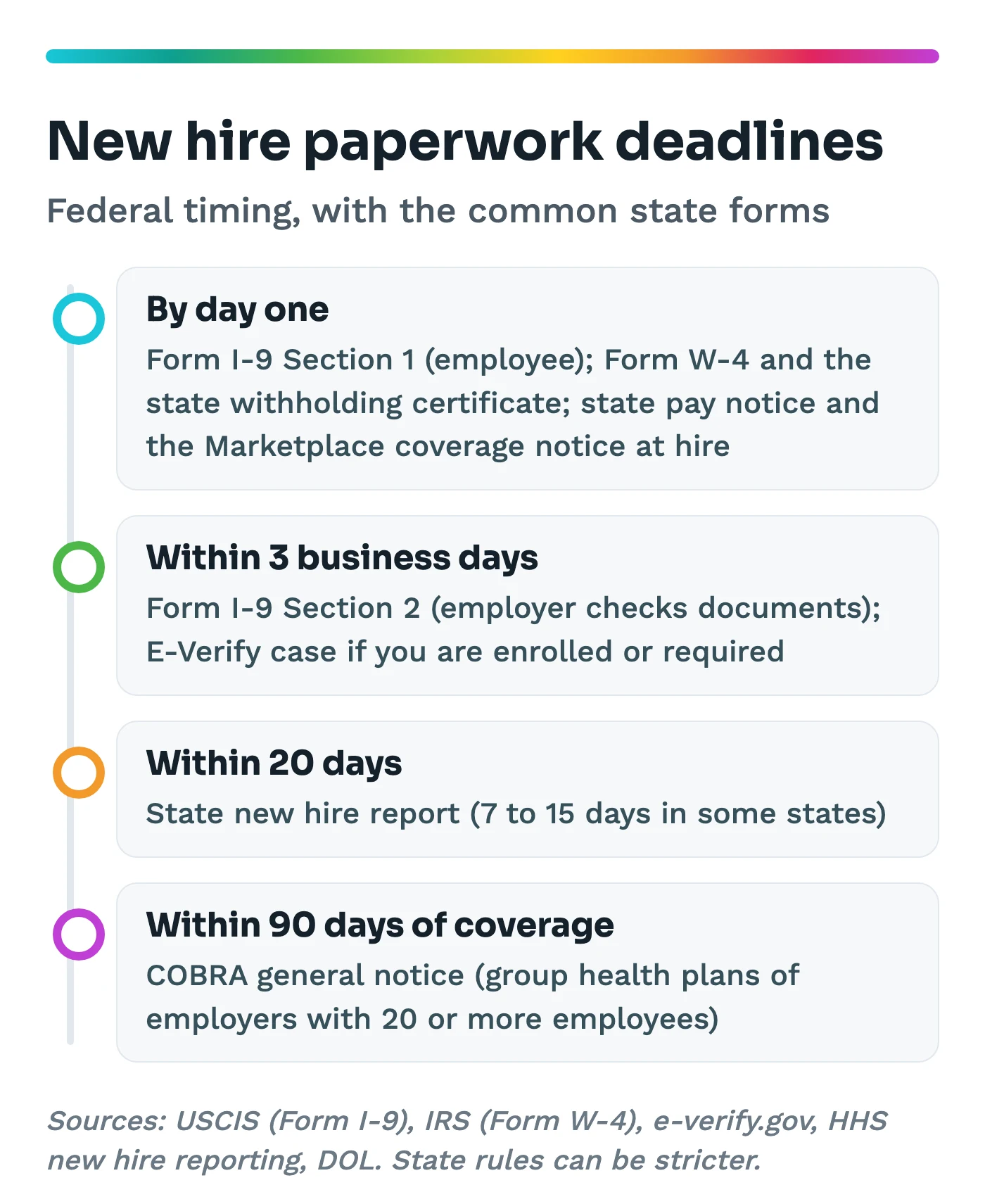
| Form or task | Who completes it | Deadline | Official source |
|---|---|---|---|
| Form W-4 (current year’s version), federal income tax withholding | Employee; employer keeps it | When the employee starts work; use it from the first paycheck | IRS Publication 15 |
| Form I-9, Section 1 | Employee | No later than the first day of employment (not before the job offer is accepted) | USCIS I-9 Central |
| Form I-9, Section 2 | Employer, after examining the employee’s documents | Within 3 business days of the first day of work; at hire if the job lasts less than 3 business days | 8 CFR 274a.2 |
| E-Verify case (if enrolled or required) | Employer | No later than the third business day after the employee starts work for pay | E-Verify User Manual |
| State withholding certificate | Employee | At hire, with the W-4 | State revenue department |
| State new hire report | Employer | Within 20 days of hire under federal law; 7 to 15 days in some states | 42 U.S.C. 653a; state directory of new hires |
| State wage or pay notice (for example New York and California) | Employer; employee signs in New York | At the time of hire | State labor department |
| Health Insurance Marketplace coverage notice | Employers covered by the FLSA | At the time of hire | DOL Technical Release 2013-02 |
| COBRA general notice | Group health plan administrator (employers with 20 or more employees) | Within 90 days after health coverage begins | 29 CFR 2590.606-1 |
Hiring paperwork is one part of a wider HR compliance checklist that also covers payroll, leave and workplace rules. The sections below take each row in turn and point to the detailed guides in this series.
Federal new hire forms: W-4, I-9 and E-Verify
Every employer needs the first two forms for every employee, whatever the company’s size. E-Verify is voluntary for most private employers but required for some. Independent contractors do not complete either form: they give you Form W-9, and you report payments to them on Form 1099.
Form W-4: the 2026 version
The IRS Publication 15 tells employers to ask all new employees for a signed Form W-4 when they start work and to make it effective with the first wage payment. If a new employee does not return a completed form, withhold as if they checked “Single or Married filing separately” and made no entries in Steps 2 through 4. You keep the form in your records; you send a W-4 to the IRS only when an IRS notice directs you to.
Two points are new or easy to miss on the 2026 Form W-4 (switch to the 2027 form, now in draft, for wages paid from January 1, 2027):
- Step 4(b) deductions worksheet: employees can now include expected deductions such as qualified tips, qualified overtime compensation, passenger vehicle loan interest and the deduction for seniors, which lowers their withholding.
- Exempt claims expire: an employee who claims exemption from withholding for 2026 must give you a new Form W-4 by February 16, 2027, to stay exempt.
Form I-9 and the current edition
Form I-9 confirms identity and work authorization for everyone you hire for pay in the United States. The employee completes Section 1 no later than the first day of employment and may do it any time after accepting the job offer. The employer then examines the original documents the employee chooses to present, from List A or from Lists B and C, and completes Section 2 within three business days of the first day of work. If someone starts on a Monday, Section 2 is due by Thursday. You cannot tell the employee which documents to bring.
The edition matters too. According to the USCIS Form I-9 page, the current edition is dated 01/20/25. The 08/01/23 edition with an expiration date of 05/31/2027 is also still accepted. The 08/01/23 version that expired 07/31/2026 can no longer be used, and employers with electronic I-9 systems had to switch by July 31, 2026. Other rules that trip up new hire packets:
- Remote review: examining documents over live video is allowed only under the DHS alternative procedure, which is limited to employers that use E-Verify and are in good standing, and you must check the alternative procedure box in Section 2.
- Language: the Spanish-language Form I-9 may be used only in Puerto Rico.
- Rehires: a former employee rehired within three years of the original form’s date can be handled on Supplement B instead of a new form.
ICE’s Form I-9 inspection fact sheet (updated August 31, 2026) lists failing to complete Section 1 or Section 2 on time as a substantive violation. Paperwork fines run from $288 to $2,861 per form. If you have never reviewed your existing forms, start with an I-9 audit checklist, and see the guide to Form I-9 penalties for 2026 for which errors now count as substantive.
E-Verify: who must use it and when
E-Verify compares the information on a completed Form I-9 with DHS and Social Security Administration records. It never replaces the I-9, and you may not use it to screen applicants before a job offer. Use is required in these situations:
- Federal contractors whose contract contains the FAR E-Verify clause (the E-Verify federal contractor rule).
- Employers in states that require it, for example every employer in Arizona under A.R.S. 23-214, and private employers with 25 or more employees in Florida since July 1, 2023, under section 448.095 of the Florida Statutes. Alabama, Mississippi and South Carolina also cover all employers, and Georgia (11 or more employees), North Carolina (25 or more), Tennessee (35 or more) and Utah (150 or more) cover private employers above a size threshold. Other states have narrower rules, often limited to public employers or state contractors, so check your state’s law.
Once you participate, create the case no later than the third business day after the employee starts work for pay. E-Verify employers also have an ongoing duty: DHS posts a Status Change Report about every two weeks listing cases created with work permits it has since invalidated, and since August 11, 2026, it covers more permit categories, including TPS and asylum-related ones. The guide to the E-Verify Status Change Report explains how to reverify those employees on Supplement B without opening a new case.
For a full walk-through of Sections 1 and 2, corrections and storage, the recorded Form I-9 compliance webinar covers the edition that expires 05/31/2027.
Tax forms for new employees: state withholding certificates
Most states with a wage income tax have their own withholding certificate, and the federal W-4 does not replace it. Examples are California’s Form DE 4, New York’s Form IT-2104 and Illinois’s Form IL-W-4. A few states base state withholding on the federal W-4 instead, and states without a wage income tax, such as Texas, Florida and Washington, have no withholding certificate at all.
Three situations create extra tax forms for new employees:
- Living in one state and working in another: the employee may need a nonresident or reciprocity certificate for the work state, or a resident-state form, depending on the two states.
- Local income taxes: some cities and school districts, for example in Ohio and Pennsylvania, tax wages and have their own forms.
- Remote employees: withholding generally follows where the work is done, so collect the forms for the employee’s work location, not your office.
Check the state revenue department’s current form each January, because states revise these certificates as often as the IRS revises the W-4.
New hire reporting: deadlines by state
New hire reporting is separate from tax withholding. Under 42 U.S.C. 653a, every employer must report each newly hired employee to the state directory of new hires in the state where the employee works. States use the reports mainly to find parents who owe child support and to issue income withholding orders. A copy of the Form W-4 can serve as the report, and most states also take online reports.
The federal report needs only these items:
- Employee name, address and Social Security number.
- The date the employee first performed services for pay.
- Employer name, address and federal employer identification number (FEIN).
Many states ask for more, such as date of birth, state of hire or whether family health coverage is available. A “newly hired employee” includes a rehire who has been separated from your company for at least 60 consecutive days. States may fine employers up to $25 per unreported employee, or up to $500 when the employer and employee conspire not to report.
States with shorter new hire reporting deadlines
Federal law sets 20 days after the hire date as the latest deadline, and each state can set a shorter one. Employers that report electronically may instead send two transmissions a month, 12 to 16 days apart. According to the federal Office of Child Support Services state new hire reporting matrix, nine states are stricter:
| State | New hire reporting deadline |
|---|---|
| Alabama | 7 days after hire |
| Maine | 7 days after hire |
| Georgia | 10 days after hire |
| Vermont | 10 days after hire |
| Massachusetts | 14 days after the employee’s or contractor’s start date |
| Rhode Island | 14 days after start date |
| West Virginia | 14 days after hire |
| Iowa | 15 days after hire or rehire |
| Mississippi | 15 days after hire |
| All other states and D.C. | 20 days after hire |
Multistate employers and independent contractors
An employer with employees in two or more states that reports electronically may send all its reports to one state, but it must first tell HHS which state it chose. Some states also want independent contractors reported. California requires a report within 20 days of paying a contractor $600 or more, or signing a contract for $600 or more, in a calendar year. Massachusetts includes contractors in its 14-day rule, and West Virginia requires reports for contractors paid $2,500 or more. Check your state’s row in the matrix before you assume contractors are exempt.
Required notices for new employees by state
Several states require a written notice of pay terms at hire, separate from any offer letter. Two of the most detailed:
- New York: Labor Law section 195(1) requires a notice of pay rate at the time of hire, covering the rate of pay, overtime rate, allowances claimed and regular payday. It must be in English and in the employee’s primary language where the state offers a template (form LS 54 for hourly workers, with LS 55 to LS 59 for other pay types). The employee signs an acknowledgment, and you keep it for six years.
- California: Labor Code section 2810.5 requires a written notice to employee at the time of hire, in the language you normally use with that employee. It does not apply to overtime-exempt employees, public employees or employees under a qualifying collective bargaining agreement. The Labor Commissioner publishes a template.
Other states require pamphlets or notices at hire on topics such as workers’ compensation, paid sick leave or harassment prevention. Your state labor department’s employer page usually lists them.
Workplace posters are not handed to each new hire, but new employees must be able to see them. Federal posters include the EEOC’s “Know Your Rights” poster and the FLSA minimum wage poster; the DOL’s FirstStep poster advisor shows which apply to you. Most states add their own.
Which benefits notices do new employees get?
Benefits paperwork runs on its own clock, usually tied to when coverage begins rather than the hire date.
- Marketplace coverage notice: every employer covered by the FLSA must give each new employee a notice about the Health Insurance Marketplace at the time of hire, whether or not the company offers a health plan. DOL publishes two model notices, one for employers with a plan and one without. Its 2013 guidance treated a notice given within 14 days of the start date as on time.
- COBRA general notice: group health plans of private employers with 20 or more employees must give the employee and spouse a written notice of COBRA rights within 90 days after coverage begins. Many states have their own continuation laws for smaller employers.
- Plan enrollment materials: the health plan’s Summary of Benefits and Coverage goes out with enrollment materials, and a retirement plan’s summary plan description is due within 90 days after the employee becomes a participant.
If a carrier, broker or payroll provider sends these for you, confirm in writing who sends what, because the legal duty stays with the plan administrator.
Pre-employment paperwork: background checks, pay ranges and AI screening
Some hiring paperwork is due before the offer, and it often sits with recruiters rather than HR.
- Background checks: under the Fair Credit Reporting Act, you must tell the applicant in writing, in a stand-alone document, that you may get a background report, and get their written permission. Before rejecting someone based on the report, you must give them a copy of it and a summary of their rights. The joint EEOC and FTC guide Background Checks: What Employers Need to Know sets out the steps. Many states and cities also limit when you may ask about criminal history.
- Pay ranges: a growing number of states require a pay range in job postings or on request. The guide to pay transparency laws by state lists which apply.
- AI screening tools: if software ranks or screens applicants, new rules may require notice or bias testing; Illinois, for example, has required employers to give notice when they use AI in hiring decisions since January 1, 2026. See the overview of AI hiring laws.
- Form I-9 timing: do not ask for I-9 documents before the offer is accepted, and do not use E-Verify to prescreen.
New employee paperwork checklist: before, on and after day one
Use this list to build the packet. Items marked “if applicable” depend on your state, plan or contracts.
- Before the start date: signed offer letter; background check disclosure and authorization (if you run one); job posting pay range checked against state law; Form I-9 Section 1 sent only after the offer is accepted.
- On or before day one: Form I-9 Section 1 completed; current year’s Form W-4; state withholding certificate; state wage notice (if applicable, such as New York’s LS 54 or California’s 2810.5 notice for nonexempt employees); Marketplace coverage notice.
- Within 3 business days: Form I-9 Section 2 completed after examining original documents; E-Verify case created (if applicable).
- Within 7 to 20 days: new hire report filed with the state directory, using your state’s deadline from the table above.
- When coverage begins and within 90 days: benefits enrollment, Summary of Benefits and Coverage, COBRA general notice and retirement plan summary plan description.
- Company forms (not required by federal law): handbook acknowledgment, direct deposit authorization (some states limit making it mandatory), emergency contacts, confidentiality or IP agreement and any required training sign-offs.
If you also hire contractors, keep them on a separate track: Form W-9, a contract and, in some states, a new hire report, but no W-4 or Form I-9.
How long do you keep new employee forms?
Retention periods differ by form, so set them form by form rather than with one rule for the whole personnel file.
- Form I-9: three years after the date of hire or one year after employment ends, whichever is later (8 CFR 274a.2). Copying the employee’s documents is optional unless you use the DHS remote examination procedure or E-Verify photo matching, which require copies. If you copy documents, do it for every employee, not selectively, and keep the copies with the form.
- Form W-4 and other employment tax records: at least four years, according to Publication 15.
- Payroll records: at least three years under the FLSA, and two years for time cards and wage rate tables (29 CFR 516.5 and 516.6).
- Applications and hiring records: at least one year from the date of the record or the hiring decision, and until any discrimination charge is resolved (29 CFR 1602.14).
- New York pay notice acknowledgments: six years.
- Medical information: results of post-offer medical exams belong in a separate, confidential medical file, not the personnel file.
Keep Forms I-9 in a separate binder or system from personnel files. That is not required, but it lets you hand inspectors the forms without the rest of the file.
What to do now
- Check your blank forms. Make sure your onboarding system uses the current year’s Form W-4 (the 2027 version from January 1, 2027), the 01/20/25 Form I-9 (or the 08/01/23 version that expires 05/31/2027) and your state’s current withholding certificate.
- Look up your new hire reporting deadline for every state where you have employees, and set the reminder to that deadline, not to 20 days.
- Add the state notices that apply where your employees work, such as New York’s pay notice or California’s 2810.5 notice for nonexempt employees.
- Assign the benefits notices. Confirm who sends the Marketplace notice, COBRA general notice and plan documents, and when.
- Train the people who handle Section 2. Hiring managers who review documents need the three-business-day rule and the document rules; HR compliance training for managers covers who should be trained and how.
- Review the full process. The recorded New Hire Legal Requirements and Process webinar walks through federal, state and local paperwork, and more sessions are listed under HR compliance webinars.
Frequently asked questions
What paperwork does a new employee need to fill out?
At minimum, the employee completes Form W-4 for federal withholding, Section 1 of Form I-9 and, in most states with an income tax, a state withholding certificate. The employer then completes I-9 Section 2, files the state new hire report and gives any required notices. Offer letters, handbook acknowledgments and direct deposit forms are company forms, not federal requirements.
What forms are required by federal law for new hires?
Form W-4 and Form I-9 are required for every employee. Federal law also requires a new hire report to the state directory of new hires, a Health Insurance Marketplace notice from FLSA-covered employers and, where a group health plan is subject to COBRA, a general notice within 90 days after coverage begins. E-Verify is required only for some federal contractors and where state law requires it.
How soon do you have to report a new hire to the state?
Federal law sets 20 days after the hire date as the latest deadline. Nine states are shorter: Alabama and Maine (7 days), Georgia and Vermont (10 days), Massachusetts, Rhode Island and West Virginia (14 days), and Iowa and Mississippi (15 days). Electronic reporters may instead send two transmissions a month, 12 to 16 days apart.
Do rehires and independent contractors need a new hire report?
A rehire counts as a new hire if they were separated from your company for at least 60 consecutive days. Contractors are reportable only in some states, including California (once payments or a contract reach $600 in a year), Massachusetts ($600 or more in a year), Maine and West Virginia ($2,500 or more). Check your state directory’s rules.
Can a new employee start work before completing Form I-9?
Yes, on the first day itself: the employee must complete Section 1 no later than the end of the first day of employment. The employer has three business days from the first day to examine documents and complete Section 2. If the job lasts less than three business days, both sections are due at hire.
Which Form I-9 should employers use in 2026?
Use the 01/20/25 edition, or the 08/01/23 edition that expires 05/31/2027. The 08/01/23 version with the 07/31/2026 expiration date is no longer valid, and electronic I-9 systems had to be updated by July 31, 2026. You do not need to redo forms completed correctly on an edition that was valid at the time.
How long should employers keep new hire paperwork?
Keep Form I-9 for three years after hire or one year after employment ends, whichever is later. Keep Forms W-4 and other employment tax records for at least four years, payroll records for three years under the FLSA, and applications and hiring records for at least one year. State rules can be longer, such as six years for New York pay notices.
Get Form I-9 right from day one
The Form I-9 compliance webinar covers the current edition, Section 2 document review, corrections, retention and E-Verify. Book one seat or the whole HR and onboarding team.
See the Form I-9 webinarSources (35)
- IRS Publication 15 (2026), Employer’s Tax Guide: Form W-4 for new employees, default withholding, four-year record retention
- IRS Form W-4 (2026), including Step 4(b) deductions worksheet and exempt renewal by February 16, 2027
- USCIS: I-9, Employment Eligibility Verification (current editions; page last reviewed 06/03/2026)
- USCIS I-9 Central: Completing Section 1 (no later than first day of employment; updated 09/11/2026)
- eCFR: 8 CFR 274a.2, verification timing (3 business days), retention, copying of documents
- USCIS I-9 Central: Remote Examination of Documents (alternative procedure; updated 09/26/2025)
- USCIS M-274, 10.0 Retaining Form I-9
- ICE: Form I-9 Inspection fact sheet (updated 08/31/2026)
- Federal Register: DHS civil monetary penalty adjustments for inflation (Jan. 2, 2025) — I-9 paperwork fines $288 to $2,861
- Federal Register: DOJ notice referencing OMB M-26-11 cancellation of 2026 penalty inflation adjustments (July 15, 2026)
- E-Verify User Manual 2.2: Create a Case (third business day rule)
- E-Verify: Who is affected by the E-Verify federal contractor rule
- E-Verify: Guidance for E-Verify employers on invalidated EADs (Status Change Report every two weeks; updated 11/17/2026)
- E-Verify: Status Change Report now includes TPS and asylum-related EADs (Aug. 11, 2026)
- Arizona Revised Statutes 23-214 (E-Verify for all employers)
- Florida Statutes 448.095 (E-Verify for private employers with 25 or more employees from July 1, 2023)
- 42 U.S.C. 653a, State Directory of New Hires (20-day rule, data elements, multistate employers, $25/$500 penalties, 60-day rehire rule)
- HHS ACF Office of Child Support Services: State New Hire Reporting Contacts and Program Requirements matrix (state pages updated through Oct. 2026)
- California EDD: Form DE 4, Employee’s Withholding Allowance Certificate
- New York State: Form IT-2104, Employee’s Withholding Allowance Certificate
- Illinois Department of Revenue: Form IL-W-4
- New York State DOL: Notice of Pay Rate (Labor Law 195(1), LS 54 and related forms)
- California DIR Labor Commissioner: Labor Code 2810.5 Notice to Employee
- DOL EBSA: Technical Release 2013-02 (Marketplace coverage notice under FLSA 18B)
- DOL EBSA: Notice of coverage options model notices
- eCFR: 29 CFR 2590.606-1, COBRA general notice (90 days)
- DOL EBSA: An Employer’s Guide to Group Health Continuation Coverage Under COBRA
- EEOC and FTC: Background Checks: What Employers Need to Know
- Illinois Public Act 103-0804 (AI in employment decisions, effective Jan. 1, 2026)
- EEOC: Know Your Rights poster
- DOL elaws FirstStep Poster Advisor
- eCFR: 29 CFR 516.5 and 516.6, FLSA record retention
- eCFR: 29 CFR 1602.14, preservation of personnel records
- South Carolina LLR: Immigration and E-Verify requirements for employers
- USCIS M-274: Retaining copies of Form I-9 documents
This article is general information, not legal or tax advice. Check the official sources above or consult a qualified advisor for your situation.
Related Blogs
HR Compliance Checklist 2027: Federal Requirements
Year-End Payroll Checklist for 2026
Related Industries
FDA Compliance
Medical Devices
Clinical Research
Audit Webinar
HR Compliance
Banking and Finance
Hospital and Healthcare
Packaging and Labeling
Accounting, Payroll and Taxation
Food and beverages
Software
Miscellaneous
Pharmaceutical