

Key points
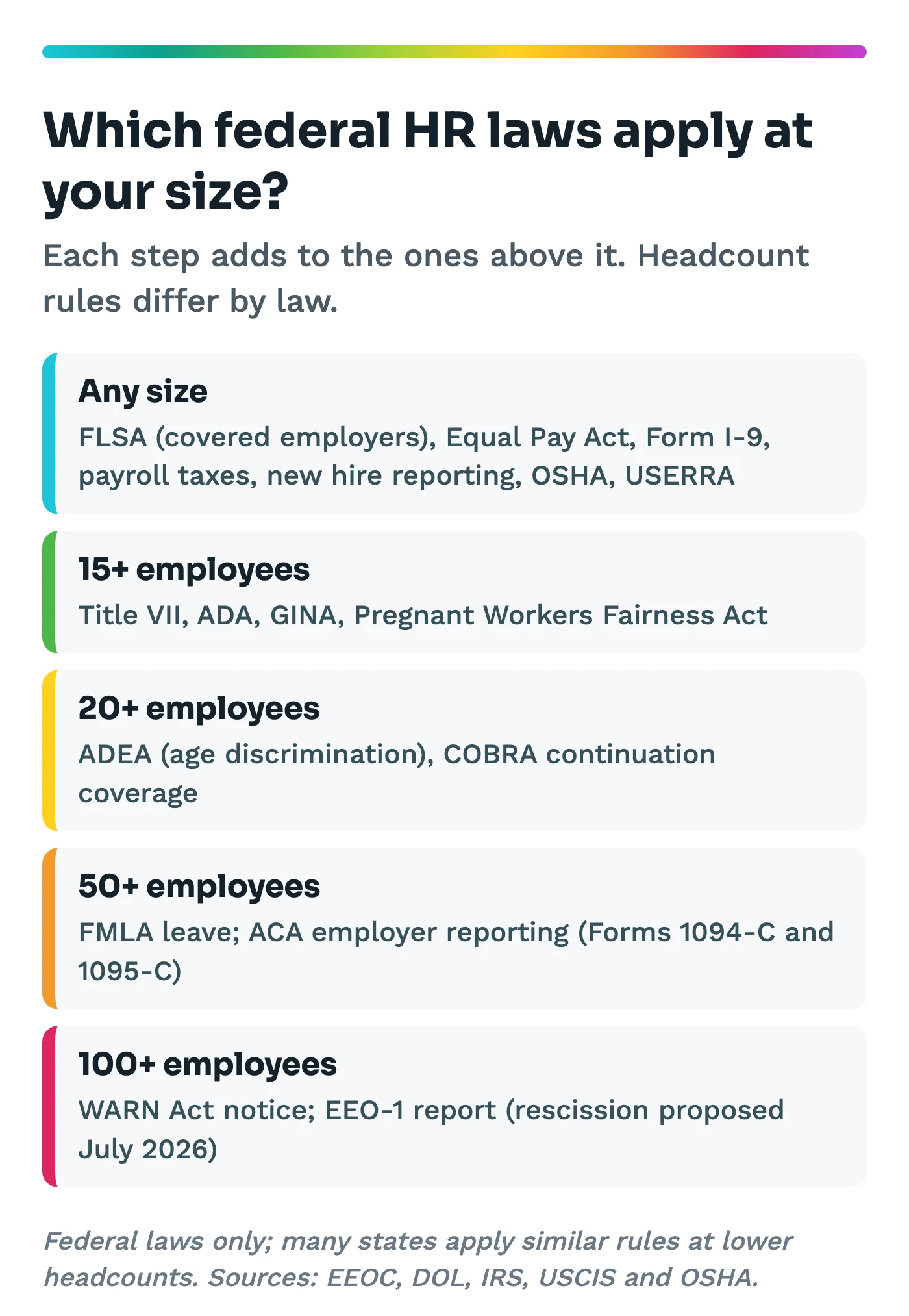
- Federal HR law turns on headcount: FLSA, Form I-9, payroll taxes, OSHA and USERRA apply from the first employee; Title VII, the ADA and the PWFA at 15; the ADEA and COBRA at 20; FMLA and ACA reporting at 50; WARN and EEO-1 at 100.
- 2026 Forms W-2 and 1099-NEC are due February 1, 2027, and the 1099-NEC threshold is $2,000 for 2026 payments.
- The OSHA 300A is posted February 1 to April 30, 2027, and applicable large employers furnish Form 1095-C by March 2, 2027.
- The federal exempt salary level is $684 a week after the DOL’s May 2026 technical amendment; the EEOC proposed ending EEO-1 reporting in July 2026, with no final rule yet.
- State law is the second layer: minimum wage, paid leave, pay transparency, harassment training and handbook rules often go further than federal law.
An HR compliance checklist lists the employment laws your organization must follow, what each one requires and when it is due. For US employers the federal list depends mostly on headcount: wage and hour rules, Form I-9, payroll taxes and OSHA apply from the first hire, while the main anti-discrimination laws start at 15 employees, age discrimination and COBRA at 20, and FMLA and ACA reporting at 50. This checklist covers the federal requirements for 2027, checked against DOL, EEOC, IRS, USCIS and OSHA sources in November 2026, plus the state rules that sit on top.
What is HR compliance?
HR compliance means following the federal, state and local employment laws that govern how you hire, pay, protect, give leave to and keep records on employees, and applying your own policies the same way to everyone. It is also called human resources compliance or HR legal compliance. Most of the work is routine: the right form at hire, the right overtime calculation, the right notice and the right retention period.
Federal enforcement is split: the Department of Labor (wages, overtime, FMLA and, through OSHA, safety), the EEOC (discrimination), the IRS (payroll tax and ACA reporting) and USCIS and ICE (Form I-9). State agencies enforce state laws, which often go further.
Headcount decides which federal laws apply, so count correctly. Under EEOC coverage rules, part-time, seasonal and temporary employees count, independent contractors and owners do not, and the threshold must be met for each working day in at least 20 calendar weeks of the current or preceding year. Other laws use their own tests: FMLA counts employees in 20 or more workweeks, and the ACA adds full-time equivalents.
HR compliance laws by employer size
The table lists the main federal HR compliance laws for private employers, the size at which each one starts and the official page to check. Federal contractors, public employers and regulated industries such as transportation and health care have extra rules that are not shown here.
| Law | Applies to | Key requirement | Official source |
|---|---|---|---|
| Fair Labor Standards Act (FLSA) | Businesses with $500,000+ in annual sales, hospitals, schools, government, and workers in interstate commerce (most employers) | $7.25 minimum wage; overtime at 1.5 times the regular rate after 40 hours a week; pay and hours records | DOL Fact Sheet #14 |
| Equal Pay Act | Employers covered by the FLSA; no minimum headcount | Equal pay for men and women doing substantially equal work | EEOC |
| Form I-9 (Immigration Reform and Control Act) | All employers, for every new hire | Employee completes Section 1 by the first day of work; employer completes Section 2 within 3 business days | USCIS Form I-9 |
| Federal payroll taxes | All employers with employees | Withhold income tax and FICA, pay FUTA, file Forms 941, 940 and W-2 | IRS employment tax due dates |
| New hire reporting | All employers | Report each new hire to the state within 20 days (some states require sooner) | HHS new hire reporting |
| Occupational Safety and Health Act | Private employers; injury logs above 10 employees, outside partially exempt industries | Safe workplace; report severe injuries within 8 or 24 hours; Forms 300, 300A and 301 | OSHA recordkeeping |
| USERRA | Virtually all employers, regardless of size | Reemploy service members after military leave and give the USERRA notice | DOL VETS USERRA guide |
| Title VII, ADA, GINA and Pregnant Workers Fairness Act | 15 or more employees | No discrimination, harassment or retaliation; accommodation for disability and pregnancy-related limitations | EEOC |
| Age Discrimination in Employment Act (ADEA) | 20 or more employees | No discrimination against applicants and employees aged 40 and older | EEOC |
| COBRA | Group health plans of employers with 20 or more employees | Offer continuation coverage and send notices after qualifying events | DOL COBRA |
| Family and Medical Leave Act (FMLA) | 50 or more employees in 20 or more workweeks; public agencies and schools at any size | Up to 12 workweeks of job-protected leave (26 for military caregiver leave) for eligible employees | DOL FMLA |
| Affordable Care Act employer reporting | 50 or more full-time employees, including full-time equivalents | File Forms 1094-C and 1095-C and furnish Form 1095-C to full-time employees | IRS Form 1094-C/1095-C instructions |
| WARN Act | 100 or more employees not counting part-time staff, or 100 or more employees (part-time included) who together work at least 4,000 hours a week, excluding overtime | 60 days’ written notice before a covered plant closing or mass layoff | DOL Employment Law Guide |
| EEO-1 report | Private employers with 100 or more employees (the separate 50-employee federal contractor trigger ended when DOL rescinded the Executive Order 11246 rules, effective October 26, 2026) | Annual workforce demographic report; rescission proposed in July 2026 | EEOC data collections |
HR compliance for small business: what applies at each headcount
Small employers often assume federal employment law starts at 15 or 50 employees. Many obligations start with the first employee:
- 1 employee: FLSA minimum wage, overtime and records (for most businesses), the Equal Pay Act, Form I-9, payroll tax withholding and filing, new hire reporting, OSHA safety duties and the OSHA poster, and USERRA.
- 11 employees: OSHA injury and illness logs, unless the business is in a partially exempt industry.
- 15 employees: Title VII, the ADA, GINA and the Pregnant Workers Fairness Act, and the EEOC “Know Your Rights” poster.
- 20 employees: the ADEA and COBRA.
- 50 employees: FMLA and ACA employer reporting.
- 100 employees: the WARN Act and the EEO-1 report, for as long as that report remains in force.
State law often lowers these thresholds: many state anti-discrimination and paid sick leave laws apply well below 15 employees.
Hiring and onboarding: what does federal law require?
Federal law requires these steps for every new employee:
- Form I-9. The employee completes Section 1 no later than the first day of work, and the employer examines documents and completes Section 2 within three business days. Use the 01/20/25 edition, or the 08/01/23 version with a 05/31/2027 expiration date, complete it for U.S. citizens too, and let the employee choose which acceptable documents to present.
- Form W-4. Collect the federal withholding certificate, and the state form where one exists, before the first payroll.
- New hire report. Report the employee to the state directory of new hires within 20 days of hire, or sooner if your state requires it.
- E-Verify where required. E-Verify is voluntary for most private employers under federal law, but federal contracts that include the E-Verify clause and several state laws make it mandatory.
- Classification. Decide before day one whether the worker is an employee or an independent contractor and, for employees, whether the job is exempt or nonexempt. For the FLSA and FMLA, DOL’s new independent contractor rule, published November 23, 2026, replaces the 2024 test from January 22, 2027.
The full onboarding packet is covered in the guide to new hire paperwork. If you already have employees, test the forms you hold with the I-9 audit checklist. ICE gives employers at least three business days to produce Forms I-9 after a Notice of Inspection, which is too short to fix errors after the notice arrives.
Hiring rules start before the offer: anti-discrimination law covers job ads and interviews, and a growing number of states require a pay range in job postings (see pay transparency laws by state).
Which wage and payroll rules apply to every employer?
Minimum wage, overtime and exempt status
The federal minimum wage is still $7.25 an hour, but most employees work in a state or city with a higher rate, and you must pay the highest rate that applies where the work is done. The federal rate still applies in 20 states; the other states and D.C. set their own, and many raise them on January 1. Check minimum wage by state before the first 2027 payroll.
Nonexempt employees earn overtime at one and a half times their regular rate for hours over 40 in a workweek, and the regular rate includes nondiscretionary bonuses and shift differentials. To treat an employee as exempt under the executive, administrative or professional exemptions, the job must meet the duties test and pay a salary of at least $684 a week. The Department of Labor restored that figure in a technical amendment published May 15, 2026, after federal courts vacated the 2024 increase; the highly compensated employee level is $107,432 a year. Some states, including California and New York, set higher exempt salary levels. The live FLSA wage and hour compliance webinar covers these rules in more depth.
Payroll taxes, W-2 and 1099 reporting
Every employer withholds federal income tax and the employee share of Social Security and Medicare, pays the employer share and federal unemployment tax (FUTA), and reports it:
- Form 941 each quarter, due on the last day of the month after the quarter ends.
- Form 940 for FUTA once a year.
- Form W-2 to each employee and to the Social Security Administration with Form W-3. 2026 Forms W-2 are due February 1, 2027, because January 31 is a Sunday.
- Form 1099-NEC for nonemployees paid $2,000 or more in 2026 (the threshold was $600 for earlier years), also due February 1, 2027.
- Electronic filing once you file 10 or more information returns in total, counting Forms W-2, 1099 and 1095-C together.
The 2026 Form W-2 adds separate reporting for qualified overtime (box 12, code TT) and cash tips (code TP), so payroll systems have to isolate the FLSA overtime premium; the details are in no tax on overtime W-2 reporting. The rest of the closing work for the year is in the year-end payroll checklist.
Anti-discrimination, leave and benefits: what starts at 15, 20 and 50 employees?
15 or more employees: Title VII, ADA, GINA and PWFA
At 15 employees, federal law bars discrimination, harassment and retaliation based on race, color, religion, sex (including pregnancy), national origin, disability and genetic information. The ADA requires reasonable accommodation for qualified employees with disabilities unless it would cause undue hardship, and the Pregnant Workers Fairness Act requires reasonable accommodation for known limitations related to pregnancy, childbirth or related medical conditions. Both work best through a documented interactive process with the employee.
No federal statute requires private employers to give harassment training. A written anti-harassment policy, a complaint procedure and trained managers are still the core of an employer’s defense to harassment claims under the Supreme Court’s Faragher and Ellerth decisions. Several states do mandate training: California requires it every two years for employers with five or more employees, and New York requires annual training for every employer. The other states are covered in harassment training requirements by state.
20 or more employees: ADEA and COBRA
The Age Discrimination in Employment Act protects applicants and employees aged 40 and older once you have 20 employees. COBRA applies to group health plans of employers with 20 or more employees in the prior year and requires continuation coverage and notices after events such as termination or reduced hours.
50 or more employees: FMLA and ACA reporting
FMLA covers private employers with 50 or more employees in 20 or more workweeks in the current or previous calendar year. An employee is eligible after 12 months of employment and 1,250 hours of service in the 12 months before leave, at a worksite with 50 or more employees within 75 miles. Eligible employees get up to 12 workweeks of job-protected leave in a 12-month period, or 26 workweeks of military caregiver leave, with group health coverage continued during leave.
An ACA applicable large employer (50 or more full-time employees, including full-time equivalents, in the prior year) files Forms 1094-C and 1095-C; the 2027 dates are in the calendar below.
100 or more employees: WARN and the EEO-1 report
The WARN Act generally requires 60 days’ written notice before a plant closing or mass layoff by employers with 100 or more employees, not counting employees who average under 20 hours a week or have worked less than six months in the last 12.
Private employers with 100 or more employees have filed an annual EEO-1 Component 1 report. That requirement is in flux: the EEOC published a proposed rule on July 23, 2026 to remove the EEO-1 and related reports, comments closed August 24, 2026, and no final rule had been published as of November 2026. The EEOC’s data collection page also has not announced a collection for 2025 data. Until a final rule appears, the reporting rule is still on the books, so keep the workforce data you would need to file.
Which workplace posters and OSHA records are required?
OSHA safety and recordkeeping
Every employer covered by OSHA must keep the workplace free of recognized serious hazards and must report a work-related death to OSHA within 8 hours, and an in-patient hospitalization, amputation or loss of an eye within 24 hours.
Employers that had more than 10 employees at any time last year, outside partially exempt industries, keep the OSHA 300 log, Form 301 incident reports and the Form 300A annual summary. A company executive certifies the 300A, which must be posted from February 1 to April 30. Establishments with 250 or more employees that must keep OSHA records, and those with 20 to 249 employees in designated industries, submit the 300A electronically by March 2; establishments with 100 or more employees in designated high-hazard industries also submit Forms 300 and 301 (29 CFR 1904.41).
Required workplace posters
Federal posters depend on which laws cover you. The DOL Poster Advisor builds a list for your business, and most private employers need:
- The FLSA minimum wage poster (employers with FLSA-covered employees).
- The EEOC “Know Your Rights” poster (employers covered by EEOC laws, generally 15 or more employees).
- The FMLA poster (covered employers, generally 50 or more employees).
- The OSHA “Job Safety and Health: It’s the Law” poster, or the state plan version.
- The Employee Polygraph Protection Act poster (most private employers).
- The USERRA notice (all employers; it may be posted or provided by mail or email).
Posters go where employees and applicants can readily see them. For the EEOC poster, electronic posting supplements the physical poster and can be the only method for an employer with no physical worksite. States and many cities add their own posters.
How long do HR records have to be kept?
Federal retention periods differ by law, and the longest one that applies wins. Keep medical information from FMLA certifications and ADA accommodation requests in separate confidential files, not in the personnel file.
| Record | Minimum federal retention | Rule |
|---|---|---|
| Form I-9 | 3 years after the hire date or 1 year after employment ends, whichever is later | USCIS Handbook M-274 |
| Payroll records (FLSA and Equal Pay Act) | 3 years | DOL Fact Sheet #21 |
| Time cards, wage rate tables and work schedules | 2 years | DOL Fact Sheet #21 |
| Employment tax records (Forms W-4, 941, W-2) | At least 4 years after the tax is due or paid, whichever is later | IRS |
| Hiring, promotion, termination and other personnel records | 1 year; for an involuntary termination, 1 year from the termination date | EEOC recordkeeping |
| ADEA payroll records | 3 years | EEOC recordkeeping |
| FMLA records | 3 years | 29 CFR 825.500 |
| OSHA Forms 300, 300A and 301 | 5 years after the end of the calendar year covered | 29 CFR 1904.33 |
| Records relevant to a discrimination charge or lawsuit | Until final disposition, including appeals | EEOC recordkeeping |
State law can require longer periods. A written retention schedule with a litigation hold step keeps records from being destroyed while a claim is pending.
How do state HR compliance laws change the checklist?
Federal law is the floor. When a state or city law gives employees more, you follow it; for minimum wage, the employee gets the higher rate. For remote employees, the law of the state and city where the employee works generally governs pay, leave and notices, not the law of your headquarters.
The state layer usually covers:
- Minimum wage, overtime (some states require daily overtime) and final paycheck deadlines.
- Paid sick leave and paid family and medical leave programs.
- Pay transparency and salary history bans.
- Harassment training, written policies and required handbook language.
- State new hire reporting, income tax withholding, unemployment insurance and workers’ compensation.
- State posters and notices, often in several languages.
Policies are where these rules collect. No federal law requires an employee handbook, but many states require specific written policies or notices, and a handbook written for one state can be wrong in another. The policies each state expects are listed in employee handbook requirements by state.
HR compliance calendar 2027: key federal dates
These are the fixed federal deadlines for calendar-year employers in 2027. When a deadline falls on a weekend or legal holiday, the IRS allows filing on the next business day, which moves several 2027 dates.
| Date | What is due | Who | Source |
|---|---|---|---|
| January 1, 2027 | State and local minimum wage increases take effect in many states | Employers in those states | State labor agencies |
| February 1, 2027 | Forms W-2 to employees and to the SSA with Form W-3 (January 31 is a Sunday) | All employers | IRS W-2/W-3 instructions |
| February 1, 2027 | Form 1099-NEC to payees and the IRS for 2026 payments of $2,000 or more | Businesses paying nonemployees | IRS |
| February 1, 2027 | Form 941 for the fourth quarter of 2026 and Form 940 for 2026 | All employers | IRS |
| February 1 to April 30, 2027 | OSHA Form 300A for 2026 posted at each establishment | Employers that keep OSHA logs | 29 CFR 1904.32 |
| March 1, 2027 | Forms 1094-C and 1095-C filed on paper | Applicable large employers allowed to file on paper | IRS 1094-C/1095-C instructions |
| March 2, 2027 | Form 1095-C furnished to full-time employees | Applicable large employers | IRS 1094-C/1095-C instructions |
| March 2, 2027 | Electronic submission of 2026 OSHA injury and illness data | Establishments meeting the OSHA size and industry thresholds | 29 CFR 1904.41 |
| March 31, 2027 | Forms 1094-C and 1095-C filed electronically | Applicable large employers | IRS 1094-C/1095-C instructions |
| April 30, 2027 | Form 941 for the first quarter; last day of the OSHA 300A posting period | All employers; employers that keep OSHA logs | IRS; OSHA |
| May 31, 2027 | Expiration date printed on both current Form I-9 versions (01/20/25 and 08/01/23); check uscis.gov/i-9 for the new date or edition before then | All employers | USCIS |
| August 2, 2027 | Form 941 for the second quarter; Form 5500 for calendar-year benefit plans unless extended (July 31 is a Saturday) | All employers; benefit plan administrators | IRS; DOL EBSA |
| Before October 15, 2027 | Medicare Part D creditable coverage notice to Medicare-eligible participants | Employers whose health plans include prescription drug coverage | CMS |
| November 1, 2027 | Form 941 for the third quarter (October 31 is a Sunday) | All employers | IRS |
| Not announced | EEO-1 report: no collection dates for 2025 or 2026 data, and rescission proposed | Employers with 100 or more employees | EEOC |
Add your state dates and benefit plan-year dates, and give each line of the HR compliance calendar one named owner.
Annual HR compliance checklist and HR audit list
Use this list once a year, and again when you cross a headcount threshold or hire in a new state.
- Headcount: Is the employee count by state current, and have you crossed 15, 20, 50 or 100 employees?
- Classification: Does every exempt employee meet the duties test and the federal and state salary levels? Are independent contractors really contractors under the DOL test that applies from January 22, 2027 and under your state’s test?
- Pay and time: Do pay rates meet the highest minimum wage at each work location, does overtime use the regular rate, and are hours recorded for every nonexempt employee, including remote staff?
- Form I-9: Is there a complete Form I-9 for every current employee and for former employees still inside the retention period?
- Payroll tax: Do the four Forms 941 reconcile to the W-2 totals? Are 1099-NEC payees checked against the $2,000 threshold?
- Leave and accommodation: Are FMLA, ADA and PWFA requests logged with notices, certifications and decisions?
- Benefits: Did COBRA notices, ACA forms and Form 5500 go out on time?
- Safety: Is the OSHA 300 log current, and was the 300A certified and posted?
- Posters and notices: Are federal, state and local posters current at every site and available to remote employees?
- Policies and training: Is the handbook current for each state, and has every required harassment training been completed and recorded?
- Records: Is there a written retention schedule, and are medical records kept separately?
How to run an HR compliance audit
- Set the scope. Pick the areas, locations and years, and decide whether counsel should direct the audit to help keep findings privileged.
- Pull the data. Export a roster with work state, job title, FLSA status, pay rate and hire date, and match it to payroll and benefits.
- Test samples. Check files against the list above. Sample neutrally, especially for Form I-9: never select employees by citizenship or national origin.
- Rank findings by risk. Unpaid wages, misclassification and missing Forms I-9 come before outdated posters and policies.
- Fix and document. Correct and date each finding, and retrain the people whose decisions caused it.
For an audit framework, the recorded HR audits webinar covers risk identification, audit tools and building an HR audit scorecard.
What to do now
- Count employees by state and mark which federal thresholds (15, 20, 50 and 100) you meet. Repeat the count every January.
- Load the 2027 calendar. Put the dates above and your state dates in a shared calendar with one owner per line.
- Update pay before January 1. Check hourly rates and exempt salaries against state increases before the first 2027 payroll.
- Run the HR audit list in the first quarter, starting with Forms I-9, classification and overtime.
- Train the people who make the decisions. Many violations start with a manager’s hiring, scheduling, leave or discipline call; see HR compliance training for managers for what that training should cover.
- Watch for 2027 changes. Review contractor relationships against DOL’s independent contractor rule before it takes effect on January 22, 2027, recheck the EEO-1 status on eeoc.gov in early 2027, and follow updates in the HR compliance webinars library.
Frequently asked questions
What are the main HR compliance laws in the US?
The core federal laws are the FLSA (minimum wage and overtime), Title VII, the ADA, the ADEA and the Equal Pay Act (discrimination), FMLA (leave), OSHA (safety), the immigration law behind Form I-9, COBRA and the ACA (health coverage), USERRA and federal payroll tax law. Which ones apply depends on headcount, and states add their own laws on top.
What HR laws apply to a business with fewer than 15 employees?
Most small businesses must still follow the FLSA, the Equal Pay Act, Form I-9 rules, payroll tax withholding and reporting, new hire reporting, OSHA and USERRA. OSHA injury logs start once you have more than 10 employees. State anti-discrimination, paid leave and wage laws often apply at much lower headcounts than federal law.
How many employees does a company need before FMLA applies?
Private employers are covered once they have 50 or more employees in 20 or more workweeks in the current or previous calendar year; public agencies and schools are covered at any size. An employee is eligible after 12 months of employment and 1,250 hours of service, at a worksite with 50 or more employees within 75 miles.
How often should you do an HR compliance audit?
No federal law sets an audit schedule for general HR compliance. Most employers review once a year, and again when they cross a headcount threshold, start hiring in a new state or face a major law change. Form I-9 and wage and hour reviews are the usual starting points because errors there carry per-form and back-pay liability.
How long should HR keep employee records?
It depends on the record: Forms I-9 for 3 years after hire or 1 year after employment ends, whichever is later; payroll records 3 years; employment tax records at least 4 years; OSHA logs 5 years; and general personnel records at least 1 year under EEOC rules. Keep anything related to a charge or lawsuit until it is fully resolved, and check state rules, which can be longer.
Is the EEO-1 report still required in 2027?
The rule is still on the books, but its future is uncertain. The EEOC proposed removing the EEO-1 and related reports on July 23, 2026, and no final rule had been published as of November 2026. The EEOC has also not opened a collection for 2025 data, so check eeoc.gov before planning any 2027 filing.
Does a small business need an employee handbook?
No federal law requires a handbook. Employers must still give certain notices and policies, such as required posters and leave notices, and many states require specific written policies. A short handbook is the usual way to deliver them and to show that rules are applied consistently.
Catch up on 2026 workplace law changes
The recorded Workplace Compliance in 2026 webinar covers the One Big Beautiful Bill Act payroll changes, new W-2 reporting, paid leave credits and state HR trends. Book one seat or the whole HR team.
See the webinarSources (37)
- EEOC: Do the federal employment discrimination laws enforced by EEOC apply to my business? (15/20-employee thresholds, counting rules)
- EEOC: Pregnant Workers Fairness Act statute (15 or more employees)
- EEOC: Recordkeeping requirements
- EEOC: Know Your Rights poster
- EEOC: EEO data collections (2024 EEO-1 closed; no 2025 collection listed)
- Federal Register: EEOC, Removal of Reporting Requirements, proposed rule (July 23, 2026; RIN 3046-AB37)
- EEOC news release: EEOC proposes rescission of annual race and sex reporting requirements (July 2026)
- DOL WHD Fact Sheet #14: Coverage under the FLSA
- DOL WHD Fact Sheet #21: Recordkeeping requirements under the FLSA
- Federal Register: DOL technical amendment restoring the $684 salary level (May 15, 2026)
- DOL news release: technical amendment restoring EAP exemption regulations (May 14, 2026)
- DOL WHD: Family and Medical Leave Act
- eCFR: 29 CFR 825.500, FMLA recordkeeping
- DOL: COBRA continuation coverage
- DOL VETS: USERRA Pocket Guide (applies regardless of employer size)
- DOL Employment Law Guide: Notices for plant closings and mass layoffs (WARN)
- DOL: Workplace posters
- DOL elaws Poster Advisor
- OSHA: Injury and illness recordkeeping and reporting
- OSHA: 29 CFR 1904.1, partial exemption for employers with 10 or fewer employees
- OSHA: 29 CFR 1904.32, annual summary posting
- OSHA: 29 CFR 1904.33, retention
- OSHA: 29 CFR 1904.41, electronic submission
- USCIS: Form I-9
- USCIS Handbook for Employers M-274: Retaining Form I-9
- USCIS Handbook for Employers M-274: Completing Section 2
- IRS: Employment tax due dates
- IRS: General Instructions for Forms W-2 and W-3 (2026)
- IRS: Instructions for Forms 1094-C and 1095-C (2026)
- IRS: How long should I keep records? (employment tax records, 4 years)
- HHS ACF: New hire reporting, answers to employer questions (20-day rule)
- DOL EBSA: Instructions for Form 5500 (due last day of 7th month after plan year)
- CMS: Creditable coverage (notice before October 15)
- New York State: Employer guide for sexual harassment prevention (annual training)
- California Civil Rights Department: Sexual harassment prevention training reminder (5+ employees, every two years)
- Federal Register: Employee or Independent Contractor Status Under the FLSA, FMLA and MSPA (final rule, November 23, 2026)
- Federal Register: Rescission of Executive Order 11246 Implementing Regulations (final rule, August 21, 2026)
This article is general information, not legal or tax advice. Check the official sources above or consult a qualified advisor for your situation.
Related Blogs
New Hire Paperwork: Federal and State Forms Checklist
Year-End Payroll Checklist for 2026
Related Industries
FDA Compliance
Medical Devices
Clinical Research
Audit Webinar
HR Compliance
Banking and Finance
Hospital and Healthcare
Packaging and Labeling
Accounting, Payroll and Taxation
Food and beverages
Software
Miscellaneous
Pharmaceutical