

Key points
- FDA requires validation of computerized systems for their intended use under 21 CFR 211.68 for drugs, Part 820 (QMSR, effective February 2, 2026) for devices and 21 CFR 11.10(a) for electronic records (with FDA’s 2003 enforcement discretion on some Part 11 provisions).
- Under the QMSR, validation of production and quality system software sits in ISO 13485 clauses 4.1.6, 7.5.6 and 7.6 (software in a device falls under design controls, clause 7.3); the old 820.70(i) is gone.
- GAMP 5 Second Edition (July 2022) groups software components into categories 1, 3, 4 and 5; category 5 custom code needs the most evidence.
- A CSV package usually runs from validation plan and URS through risk assessment, IQ, OQ and PQ and a traceability matrix to a validation summary report.
- FDA’s February 2026 CSA guidance scales testing to process risk for device production and quality system software; it changes how much evidence is expected, not whether to validate.
Computer system validation (CSV) is the documented proof that a computerized system used in FDA-regulated work does what it is supposed to do, every time, and keeps its records trustworthy. FDA does not hand you a CSV template. It expects you to validate software for its intended use under the drug CGMP rule (21 CFR 211.68), the device quality management system regulation (QMSR, Part 820, in force since February 2, 2026) and 21 CFR Part 11. This guide covers those rules, the GAMP 5 categories, the validation steps and the documents an inspector will ask for.
What is computer system validation (CSV)?
FDA’s General Principles of Software Validation (January 2002) defines software validation as confirmation, by examination and objective evidence, that software specifications meet user needs and intended uses and that the requirements built into the software can be met consistently. Computerized system validation applies that idea to the whole system: the software, the hardware or cloud service it runs on, the people who use it and the procedures around it. People also call it computer validation, CSV validation or, in drug companies, simply “CSV pharma” work.
The key phrase is intended use. FDA’s data integrity Q&A guidance (December 2018) says that each CGMP workflow on a computer system, such as creating an electronic master production and control record, is an intended use that must be checked through validation. Qualifying a manufacturing execution system platform does not prove that a given batch record template calculates correctly; validating the workflow does.
Systems that usually fall in scope include:
- Laboratory systems: LIMS, chromatography data systems and instrument software.
- Manufacturing systems: MES, PLC and SCADA controls, building management systems that monitor GMP areas, and ERP modules that release or track materials.
- Quality systems: eQMS (CAPA, deviations, change control, complaints), document management and learning management systems.
- Clinical systems: EDC, eTMF and safety databases.
- Spreadsheets and small tools that calculate or store GxP data.
FDA requirements for computerized system validation
No single FDA regulation is titled “computer system validation.” The duty comes from the predicate rule for your product type, plus Part 11 when records or signatures are electronic. FDA guidance documents explain how the agency expects you to meet those rules, but guidance itself is not binding.
| Product or activity | Rule that requires validation | What it says | Main FDA guidance |
|---|---|---|---|
| Drugs and biologics (CGMP) | 21 CFR 211.68, with 211.63 and 211.110(a) | Computers must perform reliably under a written program of checks; access to master records is controlled; inputs and outputs are checked; backup data are kept | Data Integrity and Compliance With Drug CGMP Q&A (2018) |
| Medical device production and quality system software | Part 820 (QMSR), which incorporates ISO 13485:2016 clauses 4.1.6, 7.5.6 and 7.6 | Validate software used in the quality management system, in production and in monitoring and measuring, before first use and after changes, in proportion to risk | Computer Software Assurance guidance (February 2026) |
| Software that is part of a device | Part 820 design controls (ISO 13485 clause 7.3) | Design verification and validation of device software functions | General Principles of Software Validation (2002) |
| Electronic records and signatures | 21 CFR Part 11, section 11.10(a) | Validate systems for accuracy, reliability, consistent intended performance and the ability to detect invalid or altered records | Part 11 Scope and Application (2003) |
| Clinical investigations | Part 11 and the clinical predicate rules | Electronic systems used to create or keep trial records are fit for purpose | Electronic Systems, Records and Signatures in Clinical Investigations Q&A (October 2024) |
Drug and biologic CGMP: 21 CFR 211.68
Section 211.68(a) lets you use automated and electronic equipment, including computers, if it performs its function satisfactorily and is routinely calibrated, inspected or checked under a written program, with records kept. Section 211.68(b) adds the computer-specific controls: only authorized people may change master production and control records, input and output must be checked for accuracy, and backup data must be exact, complete and protected. FDA cites 211.68 in warning letters when firms cannot show that a system was validated for the way it is actually used.
Medical devices under the QMSR (since February 2, 2026)
The QMSR final rule, published February 2, 2024, took effect on February 2, 2026. It removed most of the old Part 820 text, including 820.70 and its paragraph (i) on automated processes, and incorporated ISO 13485:2016 by reference. Software validation for device makers now sits in ISO 13485 clause 4.1.6 (software used in the quality management system), 7.5.6 (software used in production and service provision) and 7.6 (software used for monitoring and measurement). Each clause asks for documented procedures and validation before first use and after changes, scaled to the risk of using the software.
Electronic records and signatures (Part 11)
Part 11 applies when you keep records required by a predicate rule in electronic form or sign them electronically. The controls Section 11.10 lists for closed systems include validation, readable copies, record protection, limited access, secure time-stamped audit trails, operational and authority checks, training, signature accountability and control of system documentation. Since 2003, FDA has said it will use enforcement discretion on some Part 11 validation and audit trail provisions, but the predicate rules still apply, and the 2026 assurance guidance states that this discretion does not cover the validation of production and quality system software required by ISO 13485 clauses 4.1.6, 7.5.6 and 7.6. For a clause-by-clause review, use the 21 CFR Part 11 compliance checklist.
GAMP 5 Second Edition: the industry framework for CSV
ISPE GAMP 5: A Risk-Based Approach to Compliant GxP Computerized Systems, Second Edition, published in July 2022, is the industry guide most pharma and biotech companies use to run computer system validation. It is not a regulation, and FDA does not require it, but inspectors know it and your procedures can cite it. The CSA guidance itself lists GAMP 5 among the industry references a manufacturer may use.
The Second Edition kept the 2008 framework and added emphasis on critical thinking, iterative and Agile development, cloud and software-as-a-service suppliers, automated testing and tools, and a new appendix on artificial intelligence and machine learning. Its core ideas:
- Life cycle: concept, project, operation and retirement, with validation work spread across all four.
- Product and process understanding: know what the system does to product quality, patient safety and data integrity before you write tests.
- Quality risk management: scale effort to risk, in line with ICH Q9(R1).
- Supplier involvement: use the vendor’s documentation and testing where you have assessed it and found it adequate.
GAMP 5 categories: software categories 1, 3, 4 and 5
GAMP 5 sorts software by how much work goes into making it fit your use, which drives the likelihood of hidden defects. Category 2 (firmware) was dropped in the 2008 edition, so the numbering skips from 1 to 3. The Second Edition renamed the categories and says they apply to the components of a system rather than the system as a whole (whole-system categories are still used for supplier assessment), and that categories 3 to 5 form a continuum.
| GAMP 5 category | Second Edition name (first edition name) | Typical examples | Usual validation focus |
|---|---|---|---|
| Category 1 | Infrastructure software, tools and IT services (infrastructure software) | Operating systems, databases, virtualization, network and monitoring tools, cloud infrastructure | Qualify and control the infrastructure; record versions; no functional testing of the software itself |
| Category 3 | Standard system components (non-configured products) | Instrument software used as supplied, off-the-shelf tools with only run-time parameters | Supplier assessment, installation checks and testing against your requirements |
| Category 4 | Configured components (configured products) | LIMS, eQMS, ERP and MES set up through configuration | Configuration specification, testing of the configured workflows, supplier assessment |
| Category 5 | Custom applications and components (custom applications) | In-house code, custom reports and interfaces, macros, scripts and complex spreadsheet logic | Full life cycle: design specification, code review, unit and integration testing, then user testing |
What GAMP 5 category 5 means in practice: custom code has no user base or service history to rely on, so you carry the burden of proof. Expect design documents, code review, developer testing and change control on the source code. Most real systems mix categories, for example a category 4 LIMS with a category 5 custom interface to an instrument. Categorize each component, then let risk, complexity and novelty set the effort.
Computer system validation steps and the V-model
The V-model is the usual picture of the CSV life cycle. Specifications run down the left side of the V, building runs across the bottom, and testing runs up the right side, with each test level checking the specification opposite it.
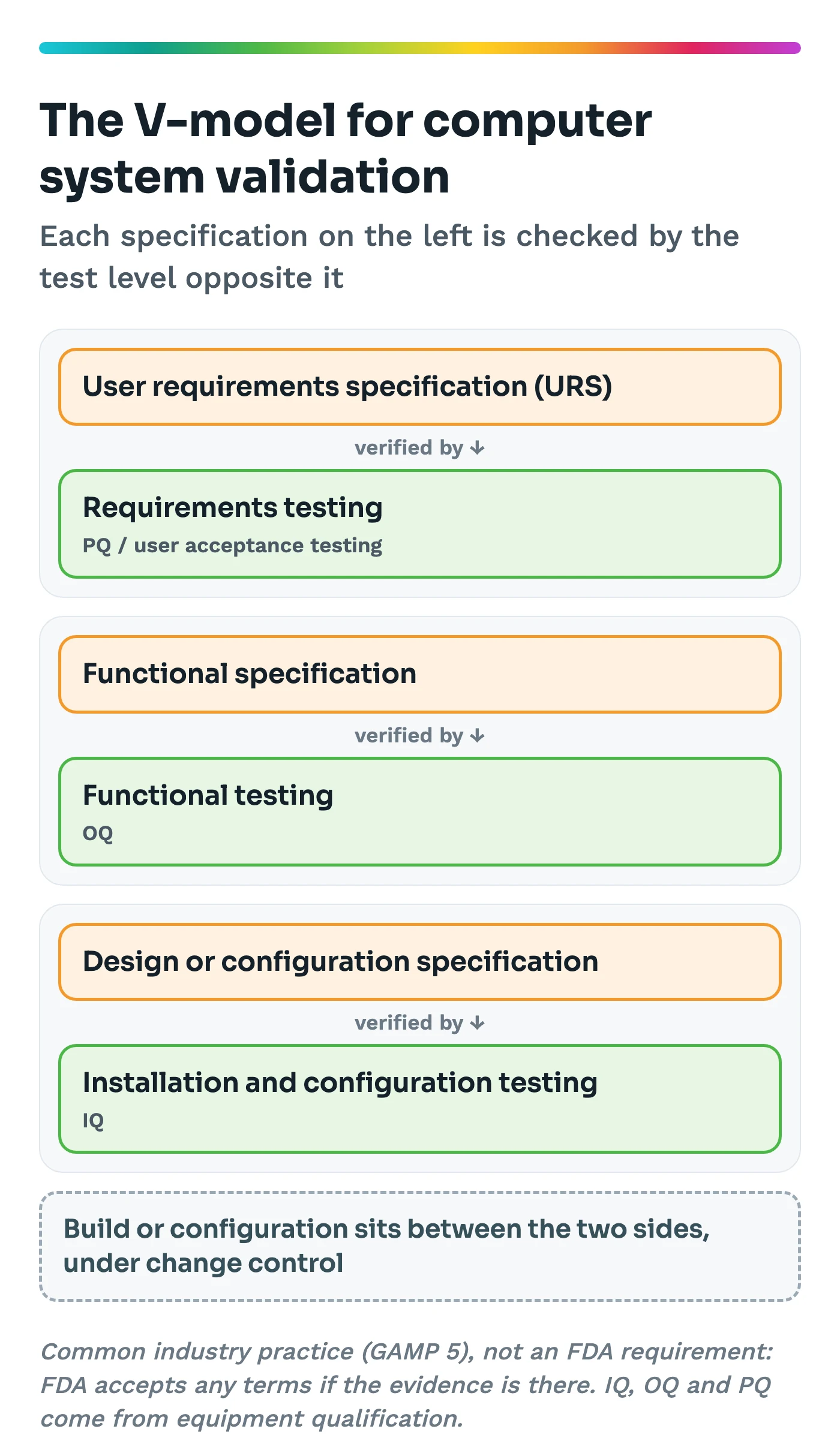
| Specification (left side) | Verified by (right side) | Common name |
|---|---|---|
| User requirements specification (URS) | Requirements testing in the user’s process | PQ or user acceptance testing |
| Functional specification | Functional testing | OQ |
| Design or configuration specification | Installation and configuration testing | IQ |
IQ, OQ and PQ come from equipment qualification and are not words found in 211.68 or Part 11. Many companies still use them for computerized systems, and FDA accepts any terms if the evidence is there. GAMP 5 Second Edition also supports iterative development, where the same mapping holds but testing runs in cycles.
A typical sequence of computer system validation steps:
- Inventory and GxP assessment. List the system, its owner and whether it creates, changes or stores GxP records or controls a GxP process.
- Validation plan. Scope, roles, deliverables, acceptance criteria and how supplier work will be used.
- User requirements. Testable statements of what the process needs, including data integrity, security, audit trail and electronic signature needs.
- Supplier assessment. Questionnaire, certification review or audit, scaled to risk.
- Risk assessment. Rate each function by its effect on patient safety, product quality and data integrity.
- Specification and configuration. Functional, design or configuration specifications, under change control.
- Testing. Installation, functional and requirements testing, with more scripted detail for high-risk functions.
- Traceability. Link every requirement to its risk rating and its test.
- Validation summary report and release. Report results, deviations and open items; QA approves release for use.
- Operation. Change control, access reviews, backup and restore tests, incident handling and periodic review.
- Retirement. Migrate or archive data so records stay readable for the full retention period.
For a step-by-step walkthrough with industry examples, the recorded computer system validation step-by-step webinar covers planning, risk assessment, GAMP 5 categories and IQ, OQ and PQ.
CSV documents: from validation master plan to summary report
Inspectors start with your procedures and your system inventory, then pick a system and ask to see its validation package. The names vary by company; the content is what counts.
| Document | What it shows | When it is written |
|---|---|---|
| Validation master plan (VMP) or CSV policy | Company approach, roles, risk method and the system inventory | Once, updated as needed |
| Validation plan | Scope, deliverables, responsibilities and acceptance criteria for one system | Project start |
| User requirements specification (URS) | What the process needs the system to do | Before selection or build |
| Supplier assessment | Evidence the vendor’s development and quality practices can be relied on | Before purchase or contract |
| Risk assessment | Which functions affect patient safety, product quality or data integrity, and how much testing each needs | After requirements, revisited during changes |
| Functional, design or configuration specification | How the system meets each requirement, including settings | Build or configuration phase |
| IQ, OQ and PQ protocols and results | Test steps, expected and actual results, evidence and deviations | Testing phase |
| Traceability matrix | Each requirement linked to risk and to the test that proves it | Built with protocols, closed before release |
| Validation summary report | Results, deviations, open items and the conclusion that the system is fit for intended use | Before release |
| Operational SOPs and training records | Change control, access, backup and restore, audit trail review, periodic review and user training | Before go-live |
Checklist before you sign the validation summary report:
- Every requirement in the URS traces to a test or a documented justification.
- All deviations are closed or have an approved plan and impact assessment.
- Audit trails are turned on, tested and covered by a review procedure.
- User roles match the approved access matrix, with no shared accounts.
- Backup and restore have been tested, not just configured.
- Users are trained on the approved procedures before go-live.
- QA has approved the report and the system has a named owner.
How to take a risk-based approach to CSV in pharma
FDA’s data integrity guidance says the extent of validation should be commensurate with the risk the automated system poses, and GAMP 5 says the same. A risk-based approach does not mean less validation everywhere. It means more evidence where a failure could hurt a patient, release a bad batch or corrupt a record, and less where it could not.
- Start with the process. Map what the system does in your workflow before you look at its features.
- Rate each function. Ask whether a failure could affect patient safety, product quality or data integrity, and how likely and detectable that failure is.
- Match the testing to the rating. Detailed scripted tests with objective evidence for high-risk functions; lighter, documented testing for low-risk ones.
- Use supplier evidence. Where you have assessed the vendor, rely on its testing for standard functions and focus your own tests on configuration and your workflows.
- Write down the reasoning. An inspector will accept less testing when the rationale is documented and holds up.
A common example: in a LIMS, the calculation that reports an assay result and the electronic signature on a release decision are high risk, while a dashboard that only displays sample counts is low risk.
Is traditional CSV still needed after FDA’s 2026 CSA guidance?
Yes, the duty to validate remains; what has changed is how much documentation FDA expects for lower-risk functions. FDA’s CDRH and CBER issued the final guidance on computer software assurance on September 24, 2025, then replaced it in February 2026 with Computer Software Assurance for Production and Quality Management System Software, updated for the QMSR. It supersedes section 6 of the 2002 General Principles of Software Validation and supplements the rest.
In summary, the guidance asks manufacturers to:
- Identify the intended use of each software feature, function or operation.
- Decide whether it poses a “high process risk,” meaning its failure may cause a quality problem that foreseeably compromises safety.
- Choose assurance activities to match: scripted testing, or scripted plus unscripted, for high process risk; unscripted methods such as scenario, error-guessing or exploratory testing for the rest.
- Keep a record of the intended use, the risk result, what was tested, issues found, the conclusion, who did it and when, using system logs and audit trails instead of screenshots where possible.
The guidance is written for medical device production and quality system software. It does not cover device software functions, and it is written for device manufacturers rather than drug manufacturers, although CDER was consulted. Like all FDA guidance, it is nonbinding. Many pharma companies apply its ideas through GAMP 5 Second Edition, which takes a similar critical-thinking approach. The guidance also notes that Part 11 generally applies when required validation evidence is kept in electronic form.
Keeping systems validated: data integrity, change control and periodic review
A validation summary report shows the system was fit for use on the day it was released. Inspectors also check whether it still is. Most CSV findings in practice come from the operation phase: changes made without assessment, audit trails nobody reviews and generic logins.
- Change control: assess every change, patch and vendor release for impact, and retest what it touches.
- Audit trail review: define who reviews which audit trails and when, as part of record review before batch release.
- Access management: unique user IDs, role-based access, prompt removal of leavers and periodic access reviews.
- Backup and restore: scheduled backups, tested restores and protection of backup copies from alteration.
- Periodic review: a scheduled check, at a risk-based interval, that the system, its documentation and its incidents still support the validated state.
Validation supports data integrity but does not replace it. The records the system produces must still be attributable, legible, contemporaneous, original and accurate, plus complete, consistent, enduring and available. The guide to ALCOA+ principles explains each one with examples. People are part of the system too: Part 11 requires that the people who develop, maintain or use these systems have the education, training and experience for their tasks, and the post on GMP training requirements covers how to plan and document that training.
If you also sell into Europe, note that the EU published a draft revision of EudraLex Annex 11 on computerised systems for consultation from July 7 to October 7, 2025. As of November 2026 the revision has not been finalized, and the 2011 Annex 11 remains in force.
What to do now
- Update your system inventory. Flag every system and spreadsheet that touches GxP data, with its owner, GAMP 5 category and last validation date.
- Check your procedures against current rules. Device makers should replace references to 820.70(i) with ISO 13485 clauses 4.1.6, 7.5.6 and 7.6 and the February 2026 assurance guidance; drug makers should confirm their CSV SOP covers intended-use workflows under 211.68.
- Add a function-level risk method. Tie test depth to patient safety, product quality and data integrity risk, and record the rationale.
- Pick one high-risk system and test it like an inspector. Trace three requirements from the URS to test evidence, then pull an audit trail review and an access review.
- Close operational gaps. Fix shared accounts, untested restores and overdue periodic reviews first; they are the easiest findings to avoid.
- Train the validation team. The live FDA computer systems compliance and enforcement webinar on December 7, 2026 covers CSV, CSA, GAMP 5 Second Edition, Part 11 and data integrity. Related sessions are listed under FDA compliance webinars.
Frequently asked questions
What is computer system validation in pharma?
It is the documented evidence that a computerized system used in GMP work, such as a LIMS, MES or eQMS, does what it is intended to do and keeps records reliable. FDA bases the requirement on 21 CFR 211.68 and, for electronic records, Part 11. Most pharma companies follow ISPE GAMP 5 to plan and scale the work.
Is computer system validation required by FDA?
Yes, for systems used in regulated activities. Drug makers validate under 21 CFR 211.68, device makers under Part 820 (ISO 13485 clauses 4.1.6, 7.5.6 and 7.6 for production and quality system software, clause 7.3 for software in the device), and anyone keeping required records electronically under 21 CFR 11.10(a), where FDA applies enforcement discretion to some validation provisions but the predicate rules still apply. FDA does not prescribe a format, so the depth and documents are yours to justify.
What are the GAMP 5 categories?
Category 1 is infrastructure software, tools and IT services; category 3 is standard system components; category 4 is configured components; and category 5 is custom applications and components. Category 2 (firmware) was dropped in 2008. The Second Edition applies the categories to components rather than whole systems.
What is GAMP 5 category 5?
Category 5 covers custom applications and components: in-house code, custom interfaces and reports, macros and complex spreadsheet logic. Because there is no user base or service history, it needs the most evidence, including design specifications, code review and developer testing before user testing.
What documents are needed for computer system validation?
A typical package has a validation plan, user requirements specification, supplier and risk assessments, functional or configuration specifications, IQ, OQ and PQ protocols with results, a traceability matrix and a validation summary report. Operational SOPs for change control, access, backup and periodic review complete it. Many companies also keep a validation master plan.
What is the difference between CSV and CSA?
CSV is the overall duty and process of validating computerized systems. CSA is FDA’s risk-based method, described in guidance for device production and quality system software, that puts more testing effort on high process risk functions and allows unscripted testing and digital records for the rest. CSA is a way to do validation, not a replacement for it.
How often should validated computer systems be reviewed?
FDA does not set a fixed interval. Companies set periodic review frequency by risk, often annually for high-risk systems and less often for low-risk ones, and record the decision in their CSV procedure. Changes, incidents and audit findings can trigger an earlier review.
Get your validation team ready for inspection
The live FDA computer systems webinar on December 7, 2026 covers CSV, CSA, GAMP 5 Second Edition, Part 11 and data integrity. Book one seat or the whole validation team.
See the CSV webinarSources (15)
- 21 CFR 211.68 Automatic, mechanical, and electronic equipment (eCFR; text read via Cornell LII)
- 21 CFR Part 11 Electronic Records; Electronic Signatures (eCFR)
- 21 CFR 11.10 Controls for closed systems (Cornell LII)
- Federal Register 89 FR 7496 (Feb 2, 2024): Medical Devices; Quality System Regulation Amendments (QMSR), effective Feb 2, 2026
- FDA: Computer Software Assurance for Production and Quality Management System Software (final, February 3, 2026; supersedes Sept 24, 2025 version)
- FDA: Computer Software Assurance guidance PDF (February 3, 2026)
- FDA: General Principles of Software Validation (final, January 2002)
- FDA: Data Integrity and Compliance With Drug CGMP Questions and Answers (December 2018)
- FDA: Part 11, Electronic Records; Electronic Signatures – Scope and Application (2003)
- FDA: Electronic Systems, Electronic Records, and Electronic Signatures in Clinical Investigations Q&A (final, October 2024)
- Federal Register notice of clinical investigations e-records Q&A guidance (Oct 2, 2024)
- ISPE: GAMP 5 Guide 2nd Edition (July 2022)
- ISPE Pharmaceutical Engineering: What you need to know about the GAMP 5 Guide, 2nd Edition (Jan/Feb 2023)
- ISPE Pharmaceutical Engineering: When a category is not a category (Jan/Feb 2026, K. Ashworth)
- European Commission: Stakeholders consultation on EudraLex Vol. 4 Chapter 4, Annex 11 and Annex 22 (July 7 – October 7, 2025)
This article is general information, not legal or tax advice. Check the official sources above or consult a qualified advisor for your situation.
Related Blogs
New Hire Paperwork: Federal and State Forms Checklist
HR Compliance Checklist 2027: Federal Requirements
Related Industries
FDA Compliance
Medical Devices
Clinical Research
Audit Webinar
HR Compliance
Banking and Finance
Hospital and Healthcare
Packaging and Labeling
Accounting, Payroll and Taxation
Food and beverages
Software
Miscellaneous
Pharmaceutical