

Key points
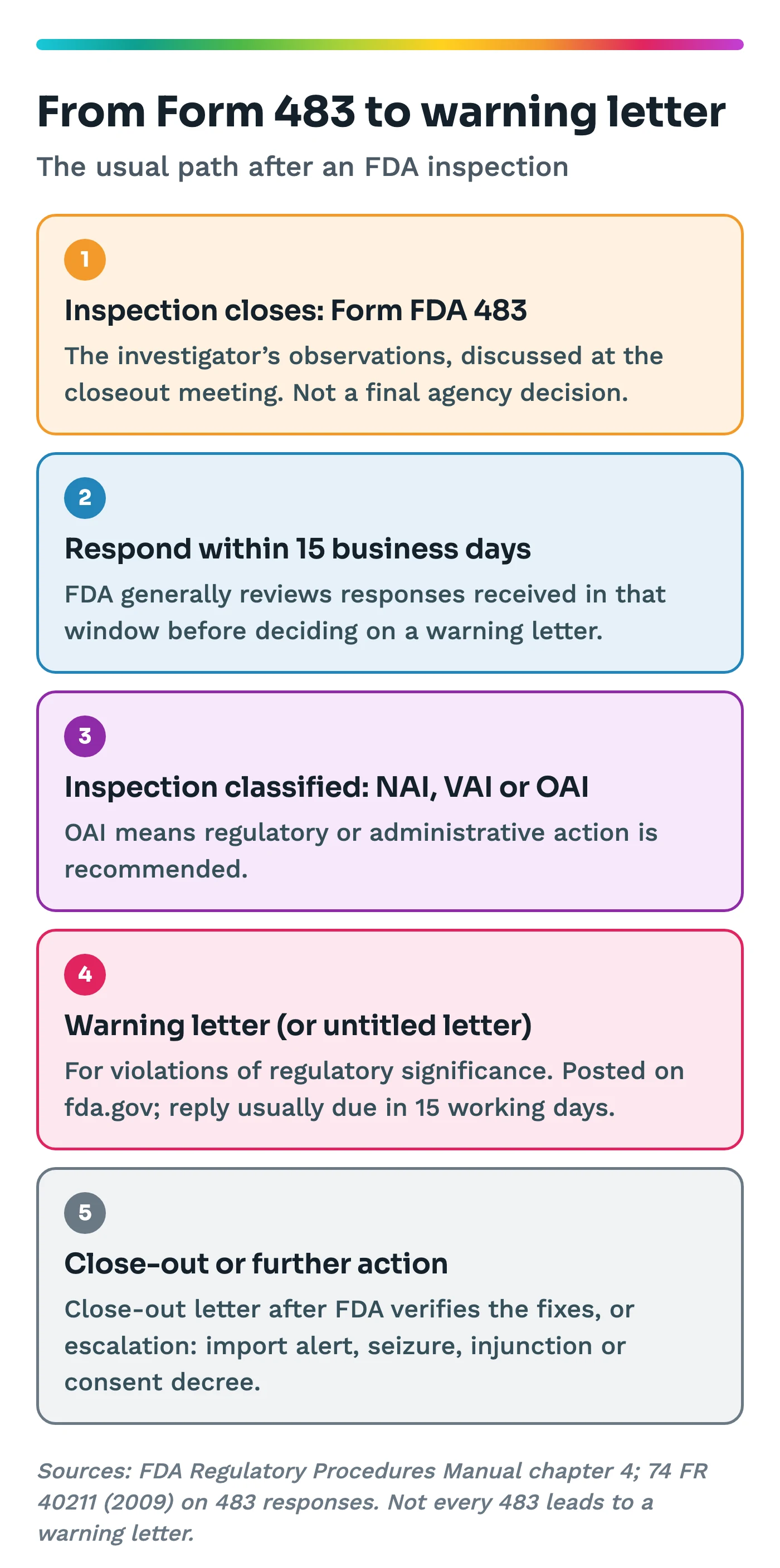
- A Form FDA 483 records an investigator’s observations at the close of an inspection; it is not a final agency determination.
- A warning letter comes later from FDA officials, only for violations of regulatory significance, and when a warning letter follows an inspection, that inspection is classified OAI.
- FDA generally reviews 483 responses received within 15 business days before deciding on a warning letter; late responses do not ordinarily delay one.
- Warning letters are posted on fda.gov and usually ask for a reply within 15 working days; close-out letters follow only after FDA verifies corrections.
- A strong response covers root cause, scope beyond the cited example, a dated CAPA plan and signed evidence, with follow-up updates.
A Form FDA 483 lists the conditions an FDA investigator found objectionable and is handed to management at the close of an inspection. A warning letter comes later, from FDA officials rather than the investigator, and says the agency considers the violations significant enough to lead to enforcement action if they are not corrected. An FDA 483 is not a final agency finding, and a written response within 15 business days lets FDA weigh your corrections before it decides on a warning letter, whether you make drugs, devices, biologics, food or other FDA-regulated products.
FDA 483 vs warning letter: the key differences
The two documents sit at different points of one process. The investigator issues the 483 on the last day of the inspection. FDA then reviews it with the investigator’s report and any response, classifies the inspection, and decides whether a warning letter, an untitled letter or no action is needed. Device inspections have followed Compliance Program 7382.850 since February 2, 2026, under the FDA QMSR, but observations still go on Form FDA 483, and FDA has said the threshold for compliance action has not changed.
| Feature | Form FDA 483 | Untitled letter | Warning letter |
|---|---|---|---|
| Who issues it | The investigator(s) who ran the inspection | An FDA compliance official, usually with center concurrence | A program office director, division director or higher official; many program areas need center concurrence |
| When | At the close of the inspection, in the closing discussion with management | After agency review, for violations below the warning letter threshold | After agency review of the 483, inspection report and any response; can also follow sample analysis or other evidence |
| Legal status | The investigator’s observations, not a final agency determination | Advisory; no warning that enforcement may follow | “Informal and advisory,” but it establishes prior notice before enforcement |
| Response | Voluntary; FDA reviews responses received within 15 business days before deciding on a warning letter | Requested, not required (for example, within 30 days) | Requested, usually within 15 working days of receipt |
| Made public? | Not automatically; selected 483s are posted or released under FOIA, redacted | Some are posted, such as letters about drug advertising | Yes, posted on fda.gov in redacted form |
| Typical next step | Response, inspection classification, release of the inspection report | Correction, checked at a later inspection | Response, follow-up inspection, then a close-out letter or escalation |
Does every Form 483 lead to a warning letter?
No. Under FDA’s Regulatory Procedures Manual (RPM), Chapter 4, warning letters are issued only for violations of regulatory significance: violations that may lead to enforcement action if not promptly and adequately corrected. FDA weighs the firm’s compliance history, the product risk, whether the firm knew of the problem, and whether its corrective action is adequate, documented and on a reasonable timeline.
Two cautions. Ongoing or promised corrections “generally do not preclude” a warning letter. And a warning letter is not a required step: FDA can go straight to enforcement when violations are repeated, intentional or flagrant, or present a reasonable possibility of injury or death. A warning letter can also arrive with no 483 at all, for example after a sample fails analysis.
What is an FDA 483? Meaning and legal status
Form FDA 483, “Inspectional Observations,” is issued to firm management at the conclusion of an inspection when the investigator has observed conditions that, in their judgment, may violate the Federal Food, Drug, and Cosmetic Act (FD&C Act) and related acts. Each observation is read and discussed with management before the investigator leaves. Some programs use their own versions, such as Form FDA 483a for Foreign Supplier Verification Program inspections and Form FDA 4056 for produce farms.
The 483 is not a full list of everything that may be wrong. FDA’s Form 483 frequently asked questions say it leaves out observations of questionable or unknown significance, and that companies are encouraged to respond in writing with a corrective action plan. For finished-drug manufacturers, 21 CFR 211.180(f) also requires procedures to notify responsible officials in writing of inspectional observations.
Is a 483 a final agency finding?
No. The form itself says the observations “do not represent a final agency determination regarding your compliance.” FDA weighs the 483 with the investigator’s Establishment Inspection Report (EIR), the evidence and your response. That is not a reason to ignore it: for drug CGMP inspections, FDA’s March 2026 draft guidance says a written response “may be the primary or a key component” of the agency’s review.
After the inspection: the EIR and NAI, VAI or OAI
The EIR is the investigator’s narrative report. FDA then assigns a final classification, usually sent to the firm in a letter within 45 to 90 days after the inspection closes, according to FDA’s Inspection Classification Database page.
| Classification | What it means | Was a 483 issued? | What usually follows |
|---|---|---|---|
| NAI (No Action Indicated) | Acceptable state of compliance | Usually not | No further action |
| VAI (Voluntary Action Indicated) | Objectionable conditions found, but FDA will not recommend action and expects voluntary correction | Usually yes | Firm corrects; FDA checks at the next inspection |
| OAI (Official Action Indicated) | Unacceptable state of compliance; regulatory action is recommended | May have been | Warning letter, untitled letter, regulatory meeting or enforcement; an inspection that leads to a warning letter is classified OAI |
Under Field Management Directive 145, FDA sends the firm a redacted copy of the EIR narrative once the inspection is closed. If the inspection led to a warning letter, untitled letter or seizure, the EIR is not released until that matter is closed.
What changed in FDA inspections in 2025 and 2026
On May 6, 2025, FDA said it would expand unannounced inspections at foreign sites making food, medicines and other medical products, and that it can take regulatory action against firms that delay, deny or limit an inspection. From April 2026 through fiscal year 2026, FDA also piloted one-day, risk-selected inspectional assessments and said the pilot did not change enforcement policy.
FDA 483 observations: what investigators cite
An observation is a condition or practice the investigator considers significant and objectionable. FDA posts yearly counts of the regulations most cited on 483s (fiscal years 2006 to 2025), though they miss hand-written 483s. Themes differ by program:
- Drugs and biologics: FDA’s draft guidance suggests firms cluster their observations by category, such as investigations, cleanrooms and staff competencies, or by the six systems: quality, production, facilities and equipment, packaging and labeling, materials, and laboratory controls. It centers on investigations of unexplained discrepancies under 21 CFR 211.192 and recommends a CGMP consultant when observations involve data integrity.
- Medical devices: trade press reported that at a May 2026 conference a CDRH official named risk management as the top observation area in the first QMSR inspections, with outsourcing and purchasing, complaint handling, UDI and corrective action also cited. An FDA QMSR inspection uses your risk files to choose what to review.
The closing discussion with management
Use the closing meeting. Ask the investigator to clarify any observation you do not understand, point out factual errors, and note corrections already made, which may be recorded on the 483. A response can also address verbal discussion items that were not written on the form. Staff preparation, conduct during the inspection and 483 responses are covered in the recorded FDA inspection and 483 webinar.
What is an FDA warning letter?
A warning letter is FDA’s principal means of getting prompt voluntary compliance and of establishing prior notice. The RPM calls it “informal and advisory”: it states the agency’s position but does not commit FDA to enforcement, and FDA does not treat it as final agency action that can be challenged in court. It is titled “WARNING LETTER,” addressed to the highest known official of the company, and cites the sections of law and regulations FDA says were violated.
Drug warning letters citing CGMP violations warn that FDA may withhold export certificates and approval of new applications or supplements that list the site. Device warning letters warn that Certificates to Foreign Governments may not be granted and that related Class III premarket approvals may be held until violations are corrected.
FDA warning letter vs untitled letter
An untitled letter cites violations that do not meet the warning letter threshold. Under RPM section 4-2-1, it is not titled, contains no warning that enforcement may follow, does not trigger mandated follow-up, and requests rather than requires a written response within a reasonable time, such as 30 days. FDA uses untitled letters for drug advertising and promotion problems, among others, and posts those on its website.
FDA warning letter response
A warning letter asks for a written response within a set time after receipt, usually 15 working days. FDA typically asks for each step taken or planned to correct the violations and prevent recurrence, the completion date, the reason for any delay, and documentation showing correction. If you believe a cited item is not a violation, send your reasoning and evidence. You can refer to your earlier 483 response and ask FDA to post your response next to the letter.
Close-out letters
For warning letters issued on or after September 1, 2009, FDA can issue a close-out letter once violations are corrected. Promises are not enough: corrections must be made and verified, usually by a follow-up inspection that finds no other significant violations. FDA posts a close-out notice, but the warning letter stays on its website unless rescinded or amended. Violations that by their nature cannot be corrected get no close-out letter.
What comes after a warning letter?
If the response is inadequate or never arrives, FDA follows up. The path is not a fixed ladder, and tools can run at once:
- Regulatory meeting: a meeting FDA management calls at its discretion to explain how a firm’s practices violate the law. Under RPM Chapter 10, it can follow a warning letter or accompany one to stress its seriousness.
- Import alert: imported products can be placed on detention without physical examination, so entries are detained and may be refused unless the importer submits evidence that overcomes the appearance of a violation.
- Withheld approvals and certificates: applications and export certificates tied to the site can stall while the inspection stays OAI.
- Seizure: a civil court action under section 304 of the FD&C Act against violative products.
- Injunction and consent decree: a court order under section 302 against the company and responsible individuals. It can be resolved by a consent decree of permanent injunction, with court-enforced remediation terms that can include stopping some or all operations until FDA agrees the firm complies.
- Civil money penalties and prosecution: available depending on the product and violation.
The RPM says FDA generally should not send a second warning letter for the same or similar violations, so a repeat finding is treated seriously. Even after a close-out letter, FDA may act without further notice if later inspections show the corrections did not hold.
Are FDA 483s public? Where to find 483s and warning letters
Warning letters are posted in redacted form on FDA’s searchable warning letters page, along with any posted responses and close-out letters. Form 483s are not published automatically. Sources for them:
- OII FOIA Electronic Reading Room: FDA’s Office of Inspections and Investigations (OII), formerly the Office of Regulatory Affairs, posts selected 483s and EIRs when it sees meaningful public interest or when three or more people have requested the same record. Records generally stay up for five years before they are archived.
- FDA Data Dashboard: inspections with their NAI, VAI or OAI classifications, 483 citations and a list of published 483s, updated weekly with final actions only. It leaves out state and pre-approval inspections and inspections still waiting for a final enforcement action, so an OAI inspection may not appear until the action is final.
- A FOIA request: anyone can request a specific 483. FDA redacts trade secrets and confidential commercial information, and the EIR is released only after the inspection is closed. Some other records may also be withheld while a compliance action is pending.
Expect more disclosure. In its Transparency Roadmap of October 2, 2026, FDA said it plans to proactively publish redacted 483s and additional EIRs where appropriate, with no schedule set as of November 2026. Write every response assuming customers and competitors may read it.
FDA 483 response: how many days do you have?
No regulation requires a response to a 483, but timing decides whether FDA reads it before deciding on a warning letter. Under a program announced in the Federal Register on August 11, 2009 (74 FR 40211), which began September 15, 2009, FDA generally allows 15 business days after the 483 is issued. A response in that window gets a detailed review, and any warning letter will comment on the apparent adequacy of your corrective actions. For a later response, FDA “will not ordinarily delay” a warning letter and will evaluate it with your warning letter response instead. FDA can still issue a warning letter at any time.
FDA’s draft guidance on responding to Form 483 observations (March 2026, docket FDA-2025-D-1504) repeats the 15-business-day recommendation for human and animal drug and biologics CGMP inspections. It is still a draft, not for implementation, as of November 2026, but it shows what reviewers look for:
- Business days are Monday through Friday, excluding federal holidays.
- If FDA amends a 483, the 15 business days run from the amendment.
- Send one response covering every observation, not piecemeal replies.
- For complex observations, send a CAPA plan and timetable within the window.
Count on a calendar. A 483 issued Friday, December 11, 2026 needs a response by Tuesday, January 5, 2027, because December 25 and January 1 are federal holidays. If federal offices also close on an extra day, such as December 24, aim for the earlier date.
Device firms have one more option. Under section 704(h)(2) of the FD&C Act, added by FDARA in 2017, they can request nonbinding feedback on proposed actions for observations involving a public health priority, systemic or major actions, or emerging safety issues. FDA’s April 2020 guidance treats a request as timely within 15 business days after the 483, and FDA then has 45 days to reply.
Follow-up updates after the first response
When fixes take longer than 15 business days, the draft guidance recommends sending preliminary results, a completion timeline and interim controls, then follow-up reports on a schedule you set in the first response. Keep every date: FDA verifies the work at the next inspection.
How to write an FDA 483 response: what to include
A strong response shows that management understands each observation, found the cause and fixed the system, not only the example the investigator saw. Steps after the closing meeting:
- Assess product risk first. Decide whether distributed product is affected and whether you need a recall, customer notice, added testing or a required report such as a drug Field Alert Report. A 483 response does not replace mandatory reports.
- Put executive management in charge. Form a cross-functional team. The draft guidance recommends that an executive who allocates resources and can carry out the commitments sign the response.
- Investigate root cause and scope. FDA’s cleaning example: if one machine was cleaned improperly and others use the same procedure, investigate all of them and every product made on them. Use structured CAPA root cause analysis and ask why your own audits missed the problem.
- Build a CAPA plan with dates. List corrections, corrective and preventive actions and interim controls, each with an owner and a realistic date, plus an effectiveness check that is more than routine sampling.
- Attach evidence. Include revised procedures, training records, investigation reports, data and photos, signed, with English translations of foreign-language documents.
- Organize and send it on time. Open with the firm name, site address and FDA Establishment Identifier (FEI), a copy of the 483, a table of contents and an executive summary. Restate each observation, then answer it. If you disagree with one on scientific grounds, give the facts and data. Send it to the address on the 483 (the drug guidance asks for email) within 15 business days.
FDA 483 response template: the executive summary table
The draft guidance suggests a summary table FDA can scan on one page. A format based on it:
| Observation | System or category | Summary of issue and CAPA | CAPA number | Target date | Status |
|---|---|---|---|---|---|
| 1. Cleaning validation (example) | Facilities and equipment | Cleaning procedure not validated for shared equipment; investigation extended to all lines | CAPA-0000 | Date, with interim controls noted | To be started, in progress or complete |
For a walk-through of response structure, the recorded Writing Effective 483 and Warning Letter Responses webinar covers the response timeline, the elements and structure of a response, a response checklist, submission and follow-up updates. More sessions are listed under FDA compliance webinars and medical device compliance webinars, and new posts in this series go out through the 247Compliance newsletter.
Frequently asked questions
What is the difference between an FDA 483 and a warning letter?
A Form FDA 483 lists an investigator’s observations at the close of an inspection and is not a final agency determination. A warning letter is issued later by FDA officials after reviewing the inspection and any response, and it states that the violations are significant and may lead to enforcement action if not corrected.
How many days do you have to respond to an FDA 483?
FDA generally allows 15 business days after the 483 is issued, under a program it announced in the Federal Register in 2009. Responses received in that window get a detailed review before FDA decides whether to issue a warning letter. Later responses do not ordinarily delay a warning letter.
Is responding to a Form 483 mandatory?
No law or regulation requires a response, and FDA describes it as voluntary. In practice, firms that do not respond within 15 business days risk FDA deciding on a warning letter without first weighing their corrective actions.
Does every 483 lead to a warning letter?
No. An inspection that ends with a 483 can be classified Voluntary Action Indicated (VAI), meaning FDA expects the firm to correct the problems on its own and recommends no action. FDA issues warning letters only for violations of regulatory significance, and it weighs the firm’s compliance history, the product risk and the adequacy of its corrective actions.
Are FDA 483s made public?
Not automatically. FDA posts selected 483s in the OII FOIA Electronic Reading Room and the FDA Data Dashboard, and anyone can request one under FOIA in redacted form. Warning letters, by contrast, are posted on fda.gov.
What happens if you ignore an FDA warning letter?
FDA will follow up, and options include a regulatory meeting, an import alert, seizure of products, an injunction or consent decree, civil money penalties or prosecution. The warning letter also documents prior notice, which FDA relies on when it considers further action.
Write a 483 response FDA can accept
The recorded webinar Writing Effective 483 and Warning Letter Responses covers the response timeline, structure, a response checklist, submission and follow-up updates. Watch it any time; recordings stay available for six months.
See the recorded webinarSources (20)
- FDA: FDA Form 483 Frequently Asked Questions
- Federal Register, Aug. 11, 2009 (74 FR 40211): Review of Post-Inspection Responses
- FDA Regulatory Procedures Manual, Chapter 4: Advisory Actions (Revision 12, July 2024)
- FDA Regulatory Procedures Manual, Chapter 10: Other Procedures (Version 04, October 2021), 10-3 Regulatory Meetings
- FDA draft guidance: Responding to FDA Form 483 Observations at the Conclusion of a Drug CGMP Inspection (March 2026)
- FDA draft guidance PDF (FDA-2025-D-1504)
- FDA guidance: Nonbinding Feedback After Certain FDA Inspections of Device Establishments (April 2020)
- 21 U.S.C. 374(h): Improvements to inspections process for device establishments
- FDA: Inspection Classification Database (NAI, VAI, OAI definitions)
- FDA Field Management Directive 145: Release of the Establishment Inspection Report (2019)
- FDA: Warning Letters
- FDA: About Warning and Close-Out Letters
- FDA: OII FOIA Electronic Reading Room
- FDA Data Dashboard: Inspections, Citations and Published 483s
- FDA: Inspection Observations (FY2006–FY2025 spreadsheets)
- FDA Voices: FDA’s Transparency Roadmap (Oct. 2, 2026)
- FDA: Import Alerts
- FDA press release: One-Day Inspectional Assessments pilot (May 6, 2026)
- RAPS: FDA official details top observations from QMSR inspections (May 14, 2026)
- eCFR: 21 CFR 211.180 and 211.192
This article is general information, not legal or tax advice. Check the official sources above or consult a qualified advisor for your situation.
Related Blogs
ACH Return Codes and Timeframes: R01 to R85 Chart
21 CFR Part 11 Compliance Checklist, Section by Section
Related Industries
FDA Compliance
Medical Devices
Clinical Research
Audit Webinar
HR Compliance
Banking and Finance
Hospital and Healthcare
Packaging and Labeling
Accounting, Payroll and Taxation
Food and beverages
Software
Miscellaneous
Pharmaceutical